
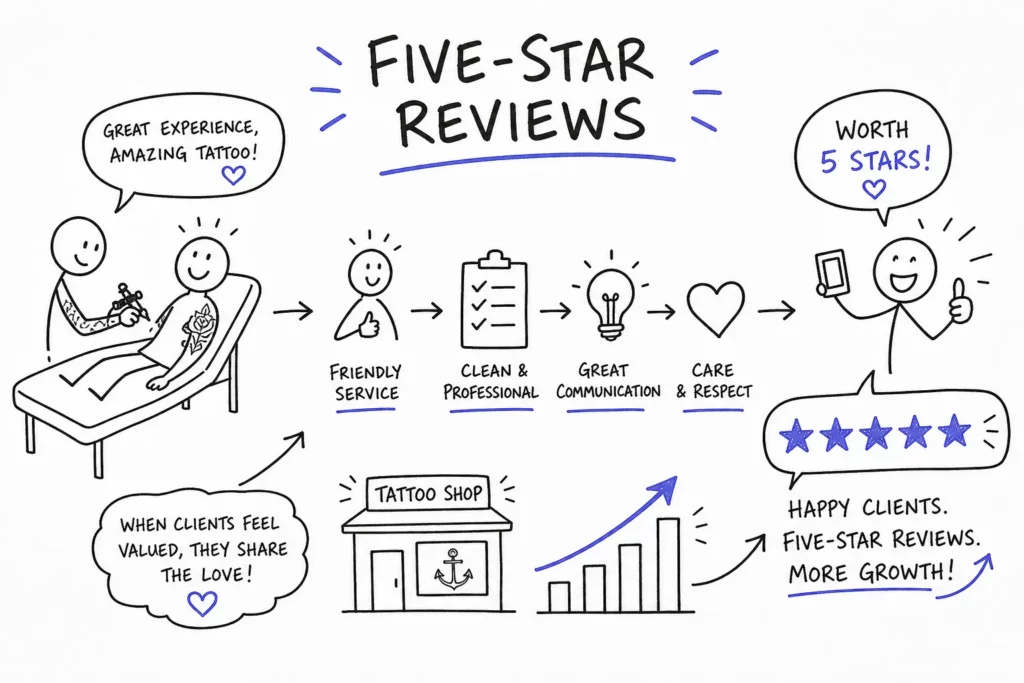
What strategies help tattoo shops consistently earn five-star customer reviews? For most studios, the answer isn’t a skill problem, it’s a system problem. Clients walk out thrilled with their new ink, genuinely grateful for the experience, and fully intending to write something up later. Then later never comes, because no one made it easy or timely for them to follow through.
A five-star reputation isn’t built on great tattoos alone. It’s built on what happens at every touchpoint: the booking confirmation, the in-session communication, the aftercare handout, and the follow-up message the next morning. Shops that earn reviews consistently have engineered those moments intentionally, not left them to chance.
This guide walks through six concrete layers of that system, from understanding what clients actually respond to, all the way through Google Business Profile optimization and review response strategy. Platforms like Tattoogenda help studios automate much of this workflow so the process runs whether you’re at the chair or not. But even before you invest in automation, understanding the fundamentals changes how you run every appointment.
What strategies help tattoo shops consistently earn five-star customer reviews
According to BrightLocal’s 2023 Local Consumer Review Survey, 97% of consumers read online reviews before visiting a local business. That number puts reviews in a different category: they’re not a nice-to-have metric, they’re a primary factor in whether someone books with you or keeps scrolling. Understanding what drives those reviews lets you design for them deliberately.
The trust signals that show up in nearly every positive review
When clients leave five-star reviews for tattoo shops, they mention a consistent set of experiences: visible cleanliness, artist professionalism, clear communication before and during the session, and a studio atmosphere that made them feel safe rather than anxious. Notice that the tattoo itself is often not the first thing mentioned. Clients are rating how they felt throughout the entire visit, not just the finished piece on their skin.
“Clear communication” has a specific meaning in this context. It means the artist explained what to expect during the session, checked in when the client needed a break, and didn’t leave them guessing about the process. Clients who felt heard and informed throughout are the ones who reach for their phones afterward and write something detailed and enthusiastic.
Why the aftercare moment matters more than most shops realize
Aftercare instructions are one of the most underrated reputation drivers in the business. Clients who receive clear, written aftercare guidance feel cared for beyond the chair, which shifts the emotional experience from a transaction to a relationship. That distinction is exactly what turns a satisfied client into an enthusiastic reviewer.
Verbal instructions at checkout aren’t enough. Clients are often tired, running on adrenaline, and not retaining details. A written handout or a follow-up digital message the next day confirms that your shop thought about them after they left. That single touchpoint correlates directly with fewer post-session complaints and more organic, detailed five-star reviews.
The operational habits that set the stage for top ratings
A great review is rarely the result of one standout moment. It’s the cumulative effect of a process that felt professional from the first confirmation message to the final handshake. These are the pre-appointment and in-session practices that make a five-star outcome the natural result rather than the lucky one.
Booking flow and consultation: where the experience actually starts
A smooth booking process shapes how a client perceives your studio before they ever walk in. Easy online scheduling, clear confirmation messages, upfront deposit collection, and a brief pre-consultation that aligns design expectations all signal one thing: this is a professional operation. Clients who arrive having already received thoughtful communication come in with higher confidence, lower anxiety, and a stronger baseline impression that carries through the session.
The consultation stage is where you earn the right to a great review before the needle even touches skin. When artists take time to listen, refine the design concept, and explain what to expect during healing, they’re removing the friction that leads to post-session complaints. Fewer complaints means fewer neutral or negative reviews diluting your average rating.
Sanitation and studio environment as a trust signal
Cleanliness isn’t just a health requirement. It’s a visible signal that shapes how clients narrate their experience in a review. Organized workstations, single-use disposables in plain sight, a dedicated sterilization area, and a studio that looks and smells clean all give clients the language to describe your shop as safe and professional. These cues don’t just pass inspections, they hand clients the exact words they’ll use when they sit down to write a review.
How and when to ask for a review without feeling pushy
The ask is where most studios either skip the step entirely or handle it in a way that feels awkward for both sides. Timing and framing are everything here, and getting both right turns a potentially uncomfortable moment into a natural extension of good customer service.
The timing window that gets the most responses
The 24-to-72-hour window after an appointment is the sweet spot for a review request. At checkout, clients are often tired, adrenaline-worn, and mentally done for the day. A follow-up message the next morning, tied to an aftercare check-in, feels helpful rather than transactional. The session is still fresh, the client has had time to reflect, and the aftercare touchpoint has already warmed the relationship before you ask for anything.
Scripts that work across text, email, and in-person
The framing of the ask matters as much as the timing. Platform terms of service, including Google’s review policies, require that you request an honest review, never a positive one. Yelp goes further: its Content Guidelines explicitly prohibit businesses from directly soliciting reviews, so the language below is designed to be genuine, non-coercive, and compliant across platforms.
- In-person closeout: “Thank you for coming in today. If you’re comfortable, I’d really appreciate an honest review of your experience on Google when you have a moment. No pressure either way.”
- Text follow-up (24 hours later): “Thanks again for visiting, hope you’re healing well. If you’d be willing to share an honest review of your experience on Google, it would really help a small studio like ours. No worries if not.”
- Aftercare check-in with review ask: “Just checking in to see how the healing is going. If your experience was a good one and you’d like to share it, we’d appreciate an honest review on Google.”
One ask, one optional follow-up. Keep it warm, keep it brief, and never tie a review request to a discount or future booking perk. That path leads to platform penalties, not more reviews.
Turning your review process into a system, not a habit
The difference between a shop with 50 reviews and one with 500 reviews isn’t effort. It’s consistency. And consistency at scale doesn’t come from memory or good intentions, it comes from a process that runs the same way every single time.
Why consistency matters more than one great ask
A studio doing 20 appointments a week cannot rely on the front desk remembering to send a follow-up text for each client. On a busy Saturday with back-to-back sessions, walk-ins, and a flash event running, manual follow-up is the first thing that falls off. When that happens, whole weeks of potential reviews simply disappear.
According to Google’s guidance on local search ranking, review signals, including volume and recency, are factored into how prominently a business appears in local results, though Google does not publish exact weighting formulas (see also BrightLocal’s annual Local Search Ranking Factors research). Volume builds credibility; recency signals that your studio is actively serving clients right now. A shop collecting reviews in irregular bursts can lose visibility ground to a competitor maintaining a steady, consistent flow. Removing the human memory requirement is the only reliable way to sustain that consistency.
How Tattoogenda automates the review collection step
Tattoogenda’s integrated review collection workflow sends automated follow-up messages timed to each appointment, so every client receives the same touchpoint at the same moment, regardless of how busy the day was. Because review requests are built into the same platform handling bookings, deposits, consent forms, and aftercare reminders, the ask arrives as part of a coherent client experience rather than a disconnected message from a different tool.
Studios using this approach stop depending on individual artists or front desk staff to remember the ask. Automated messages are triggered by appointment records, so follow-ups go out to every client regardless of staff workload or how late in the day they booked. That reliability converts a review strategy into a review system, and a consistent review system, over time, supports the kind of steady volume and recency that can strengthen your local visibility and help build a strong average rating. For examples of how studios increase review volume with purpose-built tools, see feedback management software.
Making your Google Business Profile work for the reviews you earn
Earning reviews is only half the equation. If your Google Business Profile isn’t optimized, those reviews won’t convert browsers into booked clients. A complete, well-maintained profile is what turns your star rating from a number into a competitive advantage.
The profile setup actions with the highest impact
Start with the basics that many shops still skip: verify the profile, select “Tattoo Shop” as your primary category, and complete every core field including address, phone, website, hours, and service descriptions. Write a keyword-natural business description that includes your city, your primary styles (fine line, blackwork, traditional, cover-ups), and what makes your studio worth visiting. This isn’t about stuffing phrases, it’s about giving both Google and prospective clients the context they need to choose you.
Healed tattoo photos are among the highest-impact visual assets you can add to your profile. They reduce buyer uncertainty in a way that fresh-ink shots don’t, because they show the client what the work actually looks like after healing. Upload a strong photo set at launch, then add new work weekly. Many local SEO guides find that a profile with recent, regularly updated photos tends to perform better than one with a large batch of older images, because update frequency signals an active, currently operating business. If you want additional industry statistics about how consumers use reviews, this online reviews statistics roundup is a useful reference.
Keeping the profile active so your reviews stay visible
A static profile loses ground to competitors who post regularly. Use GBP Posts to announce walk-in availability, flash events, and guest artists. Keep your hours current, including holiday closures. Enable messaging and set quick replies for common questions about pricing, availability, and booking. Maintain consistent name, address, and phone data across every directory your shop appears in. These maintenance actions are the amplification layer that ensures your five-star rating is the first thing a local searcher encounters.
Responding to reviews in a way that builds your reputation
How you respond to reviews is as visible as the reviews themselves. Prospective clients read responses carefully, particularly the responses to criticism, because that’s where they learn how your studio actually operates under pressure.
Response templates that work for every review type
Each review type calls for a different approach. Keep the response goal front of mind as you write.
For positive reviews, be brief, warm, and specific: “Thank you, [Name]. We’re so glad the session felt comfortable and that you’re happy with how it’s healing. We’d love to work with you again.”
For neutral reviews, acknowledge the mixed experience, thank them genuinely, and open a light follow-up path: “Thank you for the honest feedback, [Name]. We’re glad parts of your visit went well and would love to hear more about what we can improve.”
For negative reviews, stay calm, take accountability, and always move the conversation offline: “We’re sorry your experience fell short of expectations, [Name]. Please reach out to us directly at [contact] so we can make this right.”
Personalization is what separates an authentic response from a copy-paste template. Using the client’s name and referencing one specific detail from their review signals that a real person read what they wrote and responded with intention. Generic replies feel like noise; specific ones feel like accountability. For ready-to-use phrasings, see BrightLocal’s review response templates.
Why responses influence future bookings more than most owners think
A thoughtful response to a one-star review often does more for your reputation than a dozen automated thank-you replies to five-star ones. Prospective clients aren’t looking for perfection. They’re looking for how your studio handles problems, because that tells them what their experience would be like if something went wrong. A studio that responds professionally to criticism demonstrates accountability, and that accountability converts a skeptical browser into a booked client far more reliably than a perfect rating ever will. Research on how online reviews influence your customers underscores how much weight prospective clients place on responses and reputation management.
Build the system, then let it work
So what strategies help tattoo shops consistently earn five-star customer reviews? The answer runs six layers deep: understanding what clients actually value, delivering a consistent experience from booking through aftercare, asking for a review at the right moment with the right words, systematizing the process so it runs without manual effort, optimizing your GBP to amplify every review you earn, and responding to feedback with intention and accountability.
For studios that want five-star reviews to become predictable rather than occasional, the biggest obstacle is almost always inconsistency. Some clients get the follow-up message. Some don’t. Some weeks the process runs. Some weeks it doesn’t. Tattoogenda exists to close that gap by handling the operational layer so your team can stay focused on the work in the chair.
Start by identifying where your current process breaks down. Is it the ask timing? The aftercare follow-up? The GBP photo set that hasn’t been updated in six months? Pick one fix this week and build from there. The system doesn’t have to be perfect on day one. It just has to start.

 English
  Dutch
Dutch  Dutch (Belgium)
  French
  German
  Spanish