

The Real Cost of No-Shows in Tattoo Studios
What Studio Data Reveals About Lost Revenue, Deposits, and Risk
A no-show is often dismissed as a scheduling inconvenience.
An empty chair. A lost hour. An unfortunate exception.
In reality, no-shows are a structural financial risk for tattoo studios, one that is rarely measured correctly.
To understand the real impact, we analyzed 831 of recorded no-show appointments from tattoo studios and calculated both:
the revenue that was lost, and
the revenue that was partially recovered through deposits.
One pattern stood out immediately:
71% of all recorded no-shows occurred in appointments where no deposit was paid.
This article explores what that means, financially and structurally, and why no-shows are not a matter of bad luck, but of system design.
This article is based on real studio data, not assumptions or averages.

"In our data, 71% of recorded no-shows occurred in appointments where no deposit was paid, exposing studios to avoidable and recurring revenue loss."
How This Analysis Was Done: methodology
We analyzed 831 recorded no-show appointments.
For each appointment, we calculated:
the value of the tattoo session, based on:
start time and end time
appointment duration
pricing model (hourly, fixed, or range)
any financial compensation already received, including:
paid deposits
deposits retained as payment after a no-show
The final metric used throughout this article is net lost revenue:
Lost revenue = session value − retained deposit (if any)
This ensures that:
deposits are never double-counted
retained deposits reduce loss, but do not erase it
loss is never overstated
Data for this analysis was extracted from Tattoogenda, a tattoo studio management system, using anonymized and aggregated records.

The Numbers: What No-Shows Really Cost
Across all 831 recorded no-shows, the results were clear.
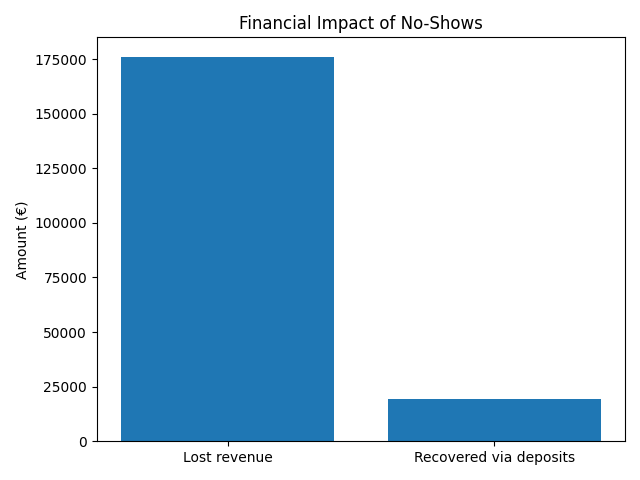
📉 Total net revenue lost
€176,145.50
This is the amount studios did not recover, even after accounting for deposits and retained payments.
An empty chair is visible.
This loss usually is not.
Average loss per no-show
Based on the analysis:
Total net revenue lost: €176,145.50
Recorded no-shows analysed: 831
👉 Average net loss per no-show: €212
(€176,145.50 ÷ 831 ≈ €211.97)

But Do No-Shows Ever “Pay”? Yes, Partially.
A second question is often overlooked:
If a client doesn’t show up, but paid a deposit, does that offset the damage?
The data shows that it helps, but only to a degree.
💰 Total revenue recovered via deposits
€19,206.00
This amount represents:
deposits that were paid upfront
or retained as payment when a no-show occurred
However, this is not profit.
It is merely damage control.
Even when deposits exist, studios still absorb the majority of the financial impact.
Most No-Shows Had No Deposit Paid
Beyond total financial impact, the data reveals a clear structural pattern.
71% of all recorded no-shows did not have a deposit paid.
In these cases:
no upfront commitment was made,
no financial protection existed at the moment of booking,
and the full session value was exposed to risk.
This does not imply that deposits completely prevent no-shows.
However, it does show a strong correlation between the absence of a deposit and the occurrence of no-shows.
Why This Correlation Matters
Appointments without a deposit combine two critical risk factors:
a higher likelihood of non-attendance, and
zero financial protection when it happens.
Deposits Don’t Stop No-Shows But They Change the Outcome
Interestingly, the data also shows that:
no-shows with a deposit still occur
but their financial impact is materially lower
Across all recorded no-shows:
studios recovered €19,206 via deposits
yet still lost €176,145 in net revenue
This highlights an important distinction:
Deposits are not a guarantee of attendance.
They are a risk-reduction mechanism.
They shift a no-show from:
a total loss
to:a partial loss
And that difference compounds significantly over time.
Why Deposits Reduce Risk But Don’t Eliminate It
Deposits change behaviour.
They introduce commitment.
They reduce casual cancellations.
But deposits typically represent:
a fraction of the session value
not full protection against long or high-value bookings
In practice:
a €600 session with a €100 deposit still leaves €500 exposed
retaining the deposit softens the blow, but does not prevent loss
This is why focusing only on whether a deposit exists is not enough.
The real question is:
How much of the session value is actually protected?
A Common Mistake: Confusing a Full Calendar with Real Revenue
Many studios judge performance by how full their calendar looks.
But a full calendar without financial commitment is not security,
it is the illusion of revenue.
No-shows reveal the gap between:
planned work
and protected income
Studios that fail to measure this gap tend to underestimate their risk.
What Tattoo Studios Can Learn From This Data
A few conclusions stand out:
No-shows should be measured in money, not just counts
Deposits reduce losses, but do not eliminate them
Long sessions carry disproportionate risk
Financial commitment should scale with session value
Studios that treat deposits as a system, not a rule, experience:
more predictable cashflow
fewer disruptive no-shows
less reactive management
Final Thought
No-shows are not bad luck.
They are a measurable financial phenomenon.
In our analysis of recorded no-shows:
studios lost €176,145.50 in net revenue, even after accounting for deposits, and
71% of no-shows occurred without any deposit paid at all.
When studios start tracking:
how much is lost,
how much is recovered,
and how much remains exposed,
their decisions around planning, deposits, and systems change permanently.
The difference is not stricter clients,
it is better structure.
 English
  Dutch
Dutch  Dutch (Belgium)
  French
  German
  Spanish