
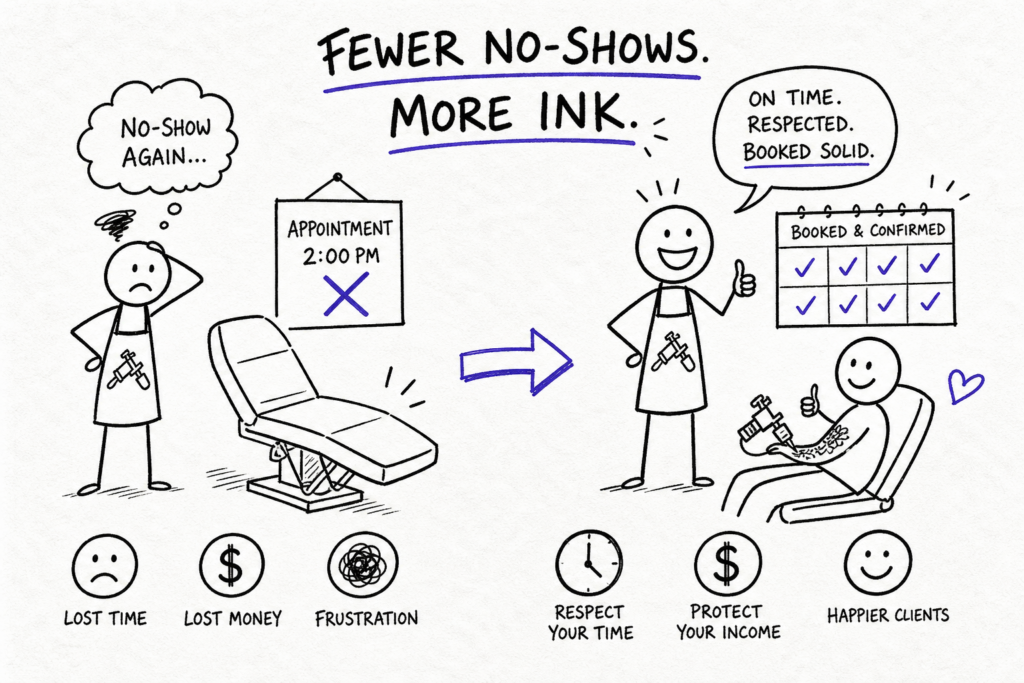
If you’re trying to figure out how to reduce no-shows at your tattoo shop, you’re dealing with a problem that hits most studios harder than they realize. Industry estimates put the range at 10 to 30 percent of booked appointments, slots that simply vanish, leaving an empty chair, wasted prep, sterilized setups tossed, and a prime spot another client would have filled. This is not random bad luck. It is a systems problem with a straightforward fix.
Studios with consistently low no-show rates tend to share three practices: a deposit collected at booking, a clear cancellation agreement, and an automated reminder sequence. Many run all three inside purpose-built appointment scheduling software for tattoo studios, so nothing slips when the shop gets busy. The goal is not more rules, it is more reliability.
In this guide you will get a working framework you can implement this week. You will set a deposit strategy, write and enforce cancellation terms, choose a reminder cadence with ready-to-use templates, and track the two metrics that tell you when to tighten the system.
1. Why no-shows cost tattoo shops more than they realize
The real cost behind an empty chair goes well beyond one lost appointment. Say an artist books a four-hour session at $150 per hour. A single no-show is $600 of lost revenue, plus design time, tray setup, sterilization, and ink and needles staged for a client who never arrived. A deposit typically covers only a portion of those costs, and the opportunity cost often stings more than the prep.
That opportunity cost is real. A serious client who could have taken the slot gets turned away, and last-minute cancellations are the hardest to refill. Many shops try to charge a no-show fee, yet without a clear policy and card-on-file, collecting it is hit or miss. The result is lost time, awkward conversations, and a calendar that no longer reflects your actual day.
The problem multiplies with your roster. A solo artist who loses two four-hour sessions in a week feels it immediately. A four-artist studio that loses just two similar sessions across the whole shop quietly eats around $1,200 a week, close to $5,000 a month, before anyone runs the numbers. This is why you should track missed appointments by artist rather than only as a shop-wide average; patterns that stay invisible in aggregate become obvious when you break them down.
2. How to reduce no-shows at your tattoo shop: build a deposit policy that filters out casual bookings
Flat vs. Percentage Deposits
Choose a structure and apply it consistently. The two most common options are a flat fee and a percentage of the estimate. Flat appointment deposits for tattoo shops typically fall between $50 and $200, simple for clients to understand and quick to calculate. Percentage-based deposits, often around 25 percent of the estimated total, scale well for large custom pieces. In both cases the deposit is deducted from the final price, so the client experiences it as a down payment, not an extra charge.
Worried a deposit will scare clients away? In appointment-based service businesses, reasonable upfront deposits improve completion rates by filtering out casual bookings and setting clear expectations from the start. Many studios report seeing cleaner booking behavior after introducing deposits, though results vary depending on clientele and how the policy is communicated. Your committed clients will appreciate a professional process that protects their time as well as the artist’s.
Make collection automatic at booking. The slot should not be held until the deposit clears, do not chase money after the confirmation. Online booking with integrated payments removes friction, stores the acknowledgment of terms, and writes a timestamped receipt into the client history. That consistency is what turns policy into practice.
Exceptions and Walk-Ins
Build in smart exceptions without weakening the rule. Same-day walk-ins and very short piercing appointments may not require a deposit. Everything else should follow the standard so your team never has to guess. Clarity reduces negotiation and keeps the calendar honest, staff shouldn’t need a judgment call every time an edge case walks through the door.
3. Write cancellation terms that hold up under pressure
Set a notice window you can actually fill. Forty-eight hours is widely used as the minimum notice window in the industry. It gives you runway to rebook and gives artists time to adjust their prep. Studios with longer wait lists often choose 72 hours. Write the window explicitly in your policy and mirror it in your reminder timing.
Use firm, professional language that leaves no gaps. Try this: “Cancellations or reschedules require at least 48-hour notice. Changes within that window are treated as cancellations and the deposit is forfeited.” Add a no-show clause: “Missed appointments with no contact forfeit the deposit and may require a larger deposit to rebook.” Vague phrasing like “we ask that you” invites pushback. Direct language prevents debates later.
Let the policy enforce itself. Require clients to acknowledge the terms during online booking, include the policy in the confirmation, and repeat the key line in the 48-hour reminder. With card-on-file or a non-refundable deposit, there is no awkward back-and-forth about fees. Clients who agree in writing rarely argue, and your team does not need to play referee.
Plan for edge cases without breaking the system. For genuine emergencies, you can move a deposit once as a courtesy and note it in the client record. Repeat last-minute cancellations should trigger a higher deposit requirement or an appointment hold until terms are met. Empathy is welcome, but consistency protects the entire shop.
4. How to reduce no-shows at your tattoo shop: set up a reminder sequence that keeps bookings on the books
Use a three-touchpoint cadence where each message does a different job: early information, final confirmation, and day-of logistics. The pattern that works well for tattoo appointments is:
- 7 days before: a soft heads-up with prep notes and a reschedule link.
- 48 hours before: a firm confirmation that repeats your cancellation window.
- Morning of: a short nudge with time, address, parking details, and what to bring.
Prioritize SMS for time-sensitive messages. Texts are opened far more reliably than emails, SMS open rates run around 98 percent compared to 20 to 30 percent for email, and responses typically come within minutes rather than hours. Some service businesses have reported significant drops in missed appointments after adding a structured text reminder system, though outcomes vary by studio and client base. A third touchpoint on the day of the appointment tends to strengthen the effect. Email still plays a role for longer prep instructions, artwork references, and receipts.
Write reminders that are warm, clear, and actionable. Example 7-day SMS: “Hi [First Name], your tattoo with [Artist] is on [Day, Date] at [Time] at [Studio]. Need to reschedule? Tap here: [Link].” Example 48-hour SMS: “Reminder for [Day] at [Time]. Changes require 48-hour notice or the deposit is forfeited. Reply C to confirm or use [Link] to adjust.” Example day-of SMS: “See you at [Time] today at [Address]. Bring ID. Reply if you are running late.” Each message includes the client’s name, time, artist, studio details, and a frictionless path to reschedule.
Add operational polish. Send messages during business hours in the client’s time zone, include “Reply STOP to opt out” for compliance, and use a single short link that lands directly on their booking. Templates keep tone consistent across artists while still feeling personal.
5. Automate deposits, reminders, and cancellations with the right software
Manual workflows create the gaps that missed appointments slip through. Spreadsheet tracking and calendar apps with no automation depend entirely on memory. When the shop gets busy, reminders do not go out and deposits get moved without a record. The very moments that need structure are the moments humans drop steps.
Tattoogenda is built specifically for tattoo and piercing studios and handles this prevention loop end to end. Clients book online, pay the deposit during checkout, and acknowledge the cancellation terms, all before the slot is confirmed. A scheduled series of SMS and email reminders goes out automatically. Digital consent forms and the client’s ink passport are sent ahead of time so check-in is fast. When a cancellation comes in, the system flags the slot and keeps the rebooking process orderly rather than chaotic. Everything connects.
In a multi-artist shop, studio management software like Tattoogenda centralizes calendars while giving each artist control over their own deposit amount, reminder preferences, and availability rules. Managers can see confirmed versus pending slots at a glance, identify repeat cancellers, and spot where the week’s gaps are, without chasing messages or digging through spreadsheets. Card-on-file and POS tools reduce friction at checkout and keep policy enforcement consistent across the whole team.
Here is how to set it up in Tattoogenda in one pass:
- Pick your deposit model and set the amount or percentage by service or artist. Then activate the “hold slot only after deposit” setting so no booking is confirmed without payment.
- Paste your cancellation terms into the booking form, confirmation email, and 48-hour SMS template. Add a checkbox acknowledgment so clients confirm they have read the policy.
- Enable the 7-day, 48-hour, and day-of reminders. Assign each message its specific job and include your reschedule link. Note that studios should test cadence timing to find what works best for their client base.
6. Track your no-show rate and know when to tighten your system
Watch two numbers every week: the raw count of missed appointments and the no-show rate as a percentage of total booked slots. If your rate climbs above 10 percent, a useful starting benchmark, though the right threshold depends on your studio’s baseline, consider adjusting deposits, moving the confirmation window to 72 hours, or reviewing where your bookings are coming from. Breaking results down by artist often reveals patterns that a shop-wide average hides entirely.
Use data to decide when to go stricter. If clients cancel within 24 hours and keep rebooking at no cost, your notice window is too loose. If certain clients habitually reschedule just inside the allowed window, add a “two reschedules maximum” clause and require a higher deposit to continue. Protect peak times with firmer terms, then ease off only when the numbers stay healthy.
Make this a quarterly habit. Review the past 12 weeks, identify outlier artists or booking channels, and tune your policy accordingly. Communicate changes clearly before they take effect, then let your automation carry the message in every confirmation and reminder going forward.
Conclusion: make no-shows rare, not routine
The framework is straightforward: collect a deposit at booking, state and enforce cancellation terms up front, and run a three-touchpoint reminder sequence automatically. Each element reduces risk on its own. Together they create a studio system where tattoo no-shows are the exception and your calendar reflects reality.
This is not about being harsh with clients. It is about running a professional shop that respects everyone’s time, including the artist’s. Many studios report cleaner days and steadier cash flow after putting these practices in place, and most see movement relatively quickly once the system is running. Results will vary, so tracking your own metrics is the only way to know what is actually working.
If you want to see how to reduce no-shows at a tattoo shop using a single connected workflow, Tattoogenda was built for exactly that. Deposits, reminders, cancellations, consent forms, and analytics, handled in one place without juggling tools. Start your setup, plug in the templates from this guide, and keep every chair working for you, not against you.

 English
  Dutch
Dutch  Dutch (Belgium)
  French
  German
  Spanish