
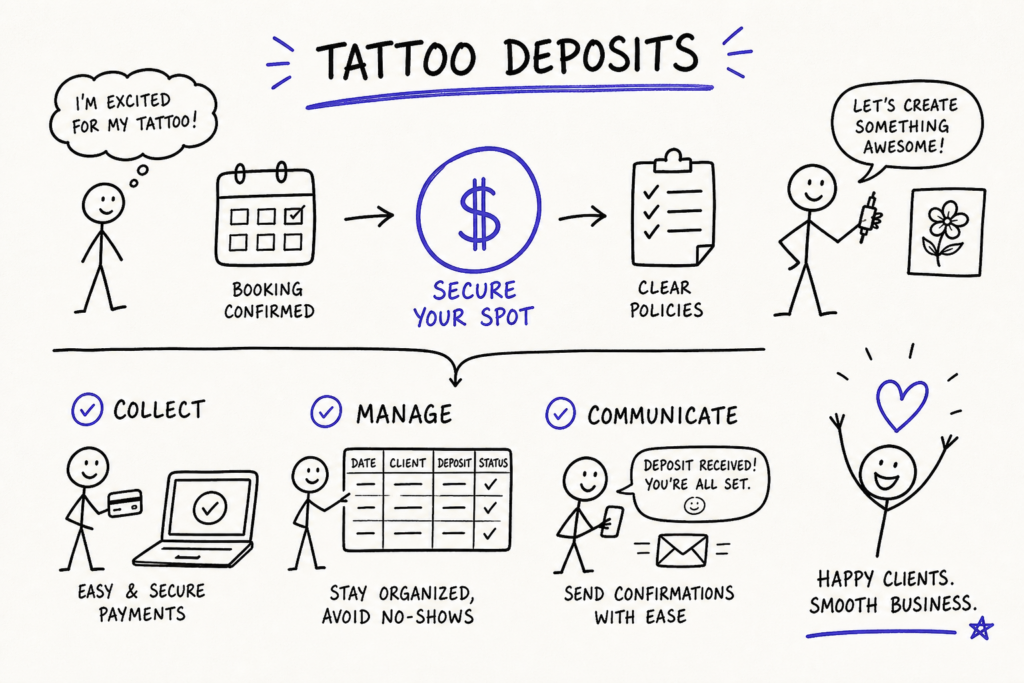
Picture the scene: you blocked out a four-hour window, spent two hours the night before finalising reference art, turned away a walk-in, and by 11am your chair is still empty. No text, no call, no explanation. The slot is gone and so is the income. This is the reality for tattoo studios that still confirm appointments on a handshake. A structured tattoo deposit collection process changes that dynamic immediately, and studios that implement one properly see their no-show rate collapse fast.
This guide gives you everything you need to build that system from scratch: the right deposit amounts for different session types, policy wording that holds up when a client pushes back, an online booking flow that collects payment automatically, and how Tattoogenda’s built-in deposit automation takes the admin work entirely off your plate. Whether you run a solo chair or a multi-artist shop, the same principles apply.
Why a weak deposit policy is costing you real money
A missed two-hour session at $150 per hour is $300 gone. Add the design prep time, the supplies laid out, and the walk-in you turned away, and the actual cost of one no-show is closer to $400 or $500. Multiply that across a month at a no-show rate between 8 and 20%, where most studios sit without a deposit system, and the number becomes genuinely uncomfortable. No-show prevention is a revenue strategy, not a customer service preference.
A deposit does something beyond protecting income: it filters for commitment. Clients who put money down to hold their spot have skin in the game. Studios consistently report that clients are far less likely to ghost an appointment when a payment is already on file. That dynamic exists because paying creates a psychological anchor. The deposit signals professionalism on both sides, not a lack of trust toward the client.
How to set the right deposit amount for any appointment
Most studios use fixed amounts because they are simple to communicate and easy to enforce. A flat $50 to $100 works well for smaller sessions; $200 to $300 is appropriate for full-day bookings. Percentage-based deposits, typically 20 to 25% of the estimated total, work better for large-scale custom work where the final cost is harder to nail down upfront. Fixed amounts win on simplicity; percentages scale better for complex projects.
Here is a practical framework based on real studio data:
- Small sessions (under 2 hours): $50 to $100
- Medium sessions (2 to 4 hours): $100 to $200
- Large or multi-session work: $200 to $600+
The logic behind the scaling is straightforward: the longer the block, the higher the opportunity cost, and the deposit should reflect that. A shop minimum of $100 ensures that even a small tattoo covers supplies, sanitation, and prep time. Whatever amount you land on, frame it clearly as a down payment that applies toward the final cost, not as a surcharge. That framing removes the most common client objection before it comes up.
Policy wording that actually holds up under pressure
The core clause
Vague language invites disputes. Specific, visible wording in a signed agreement is what makes a booking deposit enforceable. The core clause should cover four things: the deposit is non-refundable, it applies to the final session cost, it is forfeited on a no-show or cancellation with less than 48 hours’ notice, and any rescheduled appointment must happen within 60 days of the original booking date. Here is a ready-to-adapt template block:
“A non-refundable deposit is required to secure your appointment. This deposit is applied toward the final cost of your tattoo. The deposit is forfeited if you cancel with less than 48 hours’ notice, fail to arrive, or arrive more than 15 minutes late without prior contact. Rescheduled appointments must take place within 60 days of the original date. Deposits are non-transferable to another person or design.”
Custom design work needs one extra clause: substantial changes to the agreed design, or a request for an entirely new drawing, require a fresh deposit, and the original is forfeited as payment for the artist’s time. You can also offer a one-time transfer exception for clients who notify the studio at least 72 hours before their appointment. If the studio cancels for any reason, the deposit is refunded in full. That reciprocity protects client goodwill and your legal standing.
Making it legally binding
Three things make a deposit policy legally binding: it must be written, the client must acknowledge it before paying, and you must have a dated record of that acknowledgment. A digital consent form with a checkbox and timestamp satisfies this requirement in most jurisdictions.
Clients who later dispute a charge with their bank lose the chargeback fight when the studio has a signed, timestamped record ready to submit as evidence. Review your policy annually and consult a local attorney for any jurisdiction-specific nuances, particularly if you operate across EU member states where consumer rights legislation adds an extra layer of consideration. For practical deposit strategies and sample policies from another studio perspective, see this guide on how to handle tattoo deposits.
Building an online tattoo deposit collection flow
The most common failure point is confirming a slot verbally and chasing payment later. The client considers themselves booked; you are waiting on a deposit that never arrives. A structured online tattoo deposit collection flow closes that gap by making payment the confirmation. Here is the sequence that works:
- Client requests an appointment via your booking page or direct message
- Studio sends a booking link with the deposit amount and policy embedded
- Client reads the policy, signs digitally, and pays the deposit
- The system confirms the appointment only after payment clears
- Client receives a confirmation email that restates the cancellation terms
Client communication at each stage matters as much as the flow itself. The booking confirmation email sets the tone. The SMS reminder sent 48 hours before the appointment doubles as a last chance to reschedule without penalty, and it should restate the cancellation window clearly. A day-of reminder does the same. Mention the policy at every touchpoint and you remove the credible “I didn’t know” defence entirely. Studies show that timely reminders significantly reduce missed appointments; for an evidence-backed look at reminder effectiveness, see this research summary: appointment reminder study. For a broad practical primer on deposit best practice, check this tattoo deposit guide.
How Tattoogenda removes friction from tattoo deposit collection
The manual version of this workflow functions, but it requires constant discipline and follow-up. Tattoogenda was built specifically for tattoo and piercing studios, which means the deposit flow is not a workaround bolted onto a generic scheduling tool. When a client books online, the deposit prompt, policy display, digital signature, and payment collection all happen in one seamless sequence. The appointment does not lock into the artist’s calendar until the deposit clears. No chasing, no manual follow-up, no ambiguity about whether a slot is actually confirmed. For a practical walkthrough of collecting deposits with Tattoogenda, see Collect deposits, Is TG a match for your studio?
Tattoogenda’s no-show fixer feature ties directly into the deposit workflow. Automated SMS and email reminders go out at set intervals before the appointment, each one reinforcing the cancellation policy. Studios using deposits alongside automated reminders report a clear, sustained drop in no-shows because the friction to simply ghost an appointment increases at every stage. The platform tracks deposit status in real time, flags upcoming appointments without confirmed deposits, and centralises all payment records for straightforward review. For an example case study of a deposit system that ended studio no-shows, see The tattoo deposit system that ends studio no-shows.
Because Tattoogenda also handles digital consent forms, client history through the ink passport, and an integrated POS, there is no patchwork of separate tools to manage. The deposit record, the signed policy, the appointment notes, and the full payment history all live in the same client profile. When a chargeback dispute does arrive, the studio has a complete, timestamped evidence trail ready to submit without scrambling through email threads or DM screenshots. That combination of automation and documentation is what separates studios running at a professional standard from those still operating on trust and goodwill alone.
Knowing whether your deposit system is actually working
Setting up a tattoo deposit collection system is not a one-time fix. It needs to be measured and adjusted. Start with a simple baseline: track the ratio of no-shows to total appointments over 30 days before implementation, then compare the same metric 30 days after. A well-structured deposit policy with automated reminders produces a clear, visible shift in that number. Having the data also gives you a concrete case for maintaining or tightening the policy when staff or clients push back on it.
Two signals tell you when an adjustment is needed. A no-show rate that has not moved after implementing deposits usually means the amount is too low to create real commitment, raise it incrementally for longer sessions and recheck the number. A noticeable drop in booking conversions, on the other hand, suggests the deposit amount or the policy communication is creating unnecessary friction. Test different rescheduling window lengths, revisit refund exception language annually based on the disputes that actually come in, and let the data drive the decisions rather than gut feel. For additional tactics on reducing no-shows and optimising reminders, see this practical guide on how to reduce no-show appointments, and for operational approaches that balance retention and commitment read How tattoo studios reduce no-shows without losing clients.
Build the system once and let it run
Studios that automate their tattoo deposit collection remove the inconsistency that makes most policies fall apart. Tattoogenda handles the deposit prompt, the digital signature, the payment collection, the reminders, and the client record in one connected workflow. Set it up once, let it run, and check your no-show rate 30 days later. The numbers will tell you everything you need to know.

 English
  Dutch
Dutch  Dutch (Belgium)
  French
  German
  Spanish