
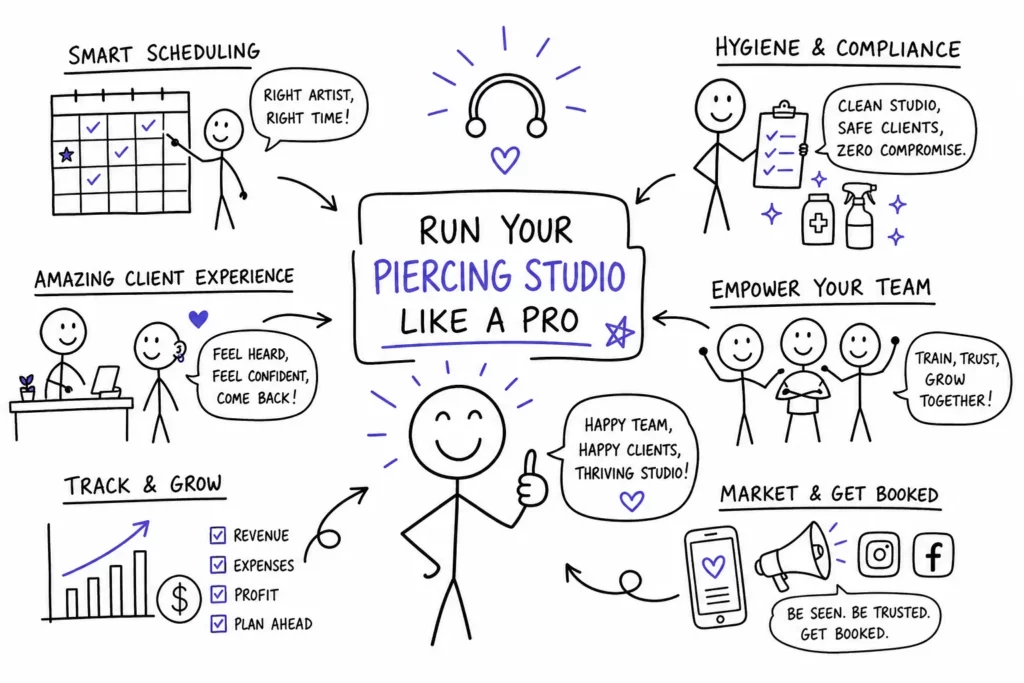
The best management tips for piercing studio owners in 2025 come down to six operational areas: client experience, bookings, health compliance, team structure, software, and revenue strategy. Most studios are competent at the craft. The ones pulling ahead have built systems around everything else.
Running a piercing studio in 2025 means holding a lot of moving parts together at once. You are managing bookings, tracking jewelry inventory, staying compliant with health codes, training staff, and trying to give every client an experience clean enough to earn a five-star review. Platforms like Tattoogenda are part of how the most organized shops in North America are automating intake, reminders, deposits, and client records so the owner can stay focused on growth rather than daily firefighting. This article covers the six operational areas where the gap between struggling and scaling shows up most clearly.
By the time you finish reading, you will have a prioritized checklist covering client experience, health compliance, team structure, software selection, and revenue strategy. Pick the area with the biggest gap in your studio and start there.
Best Management Tips for Piercing Studio Owners in 2025: Client Experience and Consent
Setting up digital intake and consent the right way
Your intake process is a trust signal before the needle ever touches skin. A paper form on a clipboard at the counter tells clients the studio runs on habit rather than intention. A clean digital workflow, completed before the client walks in, signals that safety and professionalism are built into every step of the experience.
Every piercing intake form should capture full name and contact information, date of birth for age verification, relevant medical history including allergies, blood-thinning medications, and skin conditions, and a clear acknowledgment of informed consent. The consent document itself should be written in plain language, not legal boilerplate, with e-signature capture, version tracking, and a time-stamped record stored in a central system. That last point is not just about convenience. It is legal protection. If a client ever disputes a procedure or outcome, a dated digital record of what they reviewed and signed is documentation that holds up. Templates and samples can help you standardize the workflow; see client intake form examples to get started.
Delivering aftercare protocols clients actually use
Verbal aftercare instructions at the end of an appointment are the baseline, not the standard. By the time a client gets home, drives past their favorite takeout spot, and settles in for the evening, most of what you said is already fuzzy. The evidence-based approach for earlobe, cartilage, nose, and oral piercings is consistent: gentle saline cleansing, strict hands-off discipline to avoid touching or twisting the jewelry, and early recognition of infection signs like increasing redness, warmth, swelling, or discharge after the first few days. Cartilage piercings carry higher risk than soft tissue because the blood supply is limited and infections can escalate quickly, so those clients especially need reinforcement. For a clear, client-facing checklist you can adapt, review this basic piercing aftercare guidance.
The most effective delivery format pairs verbal guidance at the appointment with an automated SMS or email follow-up sent the same day. Clients get a reference they can actually find when they need it, at 11pm when they are worried about a little swelling. That follow-up message also serves a second purpose: it is a natural touchpoint to request a review or invite a check-in booking. Studios that use automated post-appointment messaging consistently generate more repeat visits and review volume than those that rely on staff to remember.
Best Management Tips for Piercing Studio Owners in 2025: Booking and No-Show Strategies
Why 24/7 online booking is no longer optional
The majority of piercing clients, especially those under 35, book outside of business hours. A studio that only takes appointments by phone is handing those clients to a competitor with an online booking link. A modern booking setup in 2025 means 24/7 self-serve scheduling, calendars specific to each piercer, buffer time built between appointments for sterilization, and real-time availability. Walk-in capacity can still coexist alongside online bookings with a dedicated buffer window, so you are not blocking your schedule entirely for drop-ins.
Using deposits to eliminate the no-show problem
A no-show on a busy Friday afternoon is revenue that cannot be recovered. That appointment slot had a cost: your piercer’s time, the prepared setup, the blocked booking window. Deposits shift that risk to the client and immediately filter out casual inquiries from serious ones. Studios that enforce a deposit-plus-cancellation policy consistently report no-show reductions of 15 to 50 percent, depending on how the policy is structured and enforced.
The workflow is straightforward. Collect a non-refundable or partially refundable deposit at booking, send an automated confirmation immediately, and follow up with reminders at 48 hours and 24 hours before the appointment. When this runs automatically through studio management software, no staff member has to track it manually. The system handles it, and the studio keeps more of its booked revenue. For practical steps and messaging ideas to reduce no-shows, review this guide on avoiding no-shows.
Meeting Health and Safety Standards Without Guesswork
What U.S. compliance actually requires from piercing studios
Piercing studios in the U.S. are regulated at the state and local level by health departments. OSHA’s Bloodborne Pathogens Standard provides the infection-control and exposure framework that most state and local body-art rules reference, but there is no single national piercing studio license. In practice, that means studios need to hold a health department operating permit, maintain bloodborne pathogen training documentation for each piercer (typically renewed annually), have a written exposure-control plan, and follow documented sharps handling and PPE protocols. Some jurisdictions also require proof of Hepatitis B vaccination or a signed declination on file.
Requirements are jurisdiction-specific and can change without much notice. California, for example, has updated its body art facility regulations multiple times in recent years, and county-level enforcement can differ significantly even within the same state. Verifying with your local health department once a year is the only reliable way to stay current. Do not assume that what was compliant three years ago still meets current standards in your county, a single outdated procedure can put your operating permit at risk during inspection. For a helpful overview from a state health source, see this body piercing studio information page.
Sterilization logs and recordkeeping that hold up to inspection
Standard sterilization expectations cover single-use needles and disposable equipment for every client, properly reprocessed reusable instruments where applicable, and documented sterilization logs for each procedure. On the client side, every piercing performed should be logged with the client name, date, piercing location, jewelry used, and the piercer’s name. A digital system makes this faster to complete at the time of service and significantly easier to retrieve when an inspector walks in. Follow industry infection control standards to ensure your processes match accepted practice; see these infection control standards for reference.
Paper files stored in binders work until the inspector asks for a specific record from eight months ago. A searchable digital client record takes seconds. That difference matters when you are standing in your studio during a routine inspection and someone is waiting for documentation.
Building a Team That Runs the Studio with Consistency
Training standards every piercer on your team needs
The baseline every piercer should hold includes an OSHA-compliant bloodborne pathogen certification renewed annually, first aid training, and any state-specific body art technician registration required by your jurisdiction. Beyond the legal baseline, APP (Association of Professional Piercers) membership and continuing education are differentiators that signal credibility to clients who do their research. Training documentation for each team member should live on file and be refreshed on schedule, not tracked from memory.
SOPs that protect the studio when key people are out
When the lead piercer calls out and no written process exists, everything slows. The opening checklist stalls, the sterilization log sits incomplete, and whoever steps in is improvising rather than executing. Standard operating procedures fix this, but only when they are written down and accessible to everyone on the floor.
Start with client intake flow, opening and closing checklists, sterilization procedures, jewelry inventory counts, and end-of-day reconciliation. Assign a role owner to each one so accountability is clear. In a multi-piercer shop, this is especially important because consistency across staff protects the client experience and the studio’s compliance posture. Onboarding new piercers also moves significantly faster when the process is documented rather than passed down verbally.
Choosing Software That Does the Heavy Lifting for You
What a piercing studio management platform should actually handle
Generic salon apps were not built for piercing workflows. A platform designed for body art studios should handle booking, deposits, digital consent forms, client history including medical notes and jewelry records, automated reminders, and integrated payments. Piercing studio best practices in 2025 also call for jewelry inventory tracking as a meaningful addition, you are carrying surgical steel, titanium, and gold pieces at different price points with real turnover to manage.
The core feature checklist for piercing shop operations looks like this:
- 24/7 online scheduling with staff-specific calendars
- Deposit collection at booking with automated confirmation
- Digital consent forms with e-signature and version history
- Client profiles with piercing history, allergy notes, and jewelry records
- Integrated POS for jewelry sales and checkout
- Automated SMS and email reminders
- Post-appointment review collection
Why Tattoogenda is built for exactly this workflow
Tattoogenda was designed by active tattoo and piercing studio owners, not by generic software developers who built a booking tool and bolted on features after the fact. That distinction matters because the workflows are industry-specific from the ground up, every screen and automation reflects how body art studios actually operate, not how a developer assumed they might.
For the operational areas covered in this article, intake, health recordkeeping, reminders, deposits, and client history, Tattoogenda automates the manual work so studio owners are not managing those tasks by hand. It also scales across multiple piercers and locations without requiring a platform change as the studio grows. When you go from one chair to four, or from one location to two, the system expands with you without disrupting the workflows already in place.
For more detailed guidance on selecting the right tools, see our related guides on Best Software to Manage Guest Artists at Your Tattoo Studio, Best tattoo studio CRM tools: features, pricing & picks, and How to Choose the Best Tattoo Studio Management Software, tattoogenda.com.
Growing Revenue Through Jewelry and Smarter Pricing Strategy
Markup, upsell timing, and pricing benchmarks that make sense
Most U.S. piercing studios use a two-part model: a service fee plus a jewelry fee. Service fees for standard piercings typically fall in the $45 to $80 range, with jewelry priced separately or bundled at a base level. On the inventory side, the standard markup for retail jewelry is roughly 200 to 300 percent over wholesale cost, which translates to a gross margin in the 67 to 75 percent range depending on the pricing tier. Higher-margin upgrades in 14k gold and premium materials are the main profit lever, not volume on basic surgical steel.
The upsell moment is the consultation and the initial appointment. That is when the client is engaged, curious, and making decisions. Guiding them through the difference between basic titanium and a 14k gold piece, explaining the healing and comfort benefits rather than leading with price, converts far more consistently than a jewelry case mentioned as an afterthought at checkout. Clients who understand the benefit usually want the better option.
Building repeat visit revenue with follow-up and upgrade offers
Piercing studios have a natural repeat-visit cycle that most owners underuse. Clients come back for jewelry changes, upgrades, check-ins, and additional piercings. That revenue does not happen automatically; it requires a system to prompt it at the right time.
Two of the highest-converting touchpoints are easy to automate and easy to overlook. Present a curated jewelry upgrade menu at the initial appointment while the client is still in the chair and engaged, that is when the conversation is natural and the decision is immediate. Then send a follow-up message at the end of the healing window with an upgrade offer and a booking link. The timing does the work. When that reminder goes out automatically at week eight, the conversion happens because the moment is right, not because a team member happened to remember. A referral incentive layered on top of those two, for clients who bring in a friend or book a second piercing, compounds the return without adding staff workload.
Your Next Move Starts with One Gap
The six pillars covered here are client experience and consent, appointment systems and no-show prevention, health compliance, team structure and SOPs, purpose-built studio software, and revenue through jewelry and smart pricing. None of these areas are complicated on their own. The challenge is running all of them in parallel while also doing the work that pays the bills.
Apply these management tips for piercing studios in 2025 and the throughline becomes clear: documented processes and the right software reduce the owner’s cognitive load and free up time for actual growth work. When intake runs automatically, reminders go out on schedule, and compliance records are a search query away, the studio runs on structure instead of memory.
Identify the one area in this article where your studio has the biggest gap and address that first. Progress compounds. If booking chaos, no-shows, or client recordkeeping are slowing you down, Tattoogenda can automate several of these moving parts from day one. Explore a free trial or book a demo to see how it maps to your studio’s workflow.
 English
  Dutch
Dutch  Dutch (Belgium)
  French
  German
  Spanish