
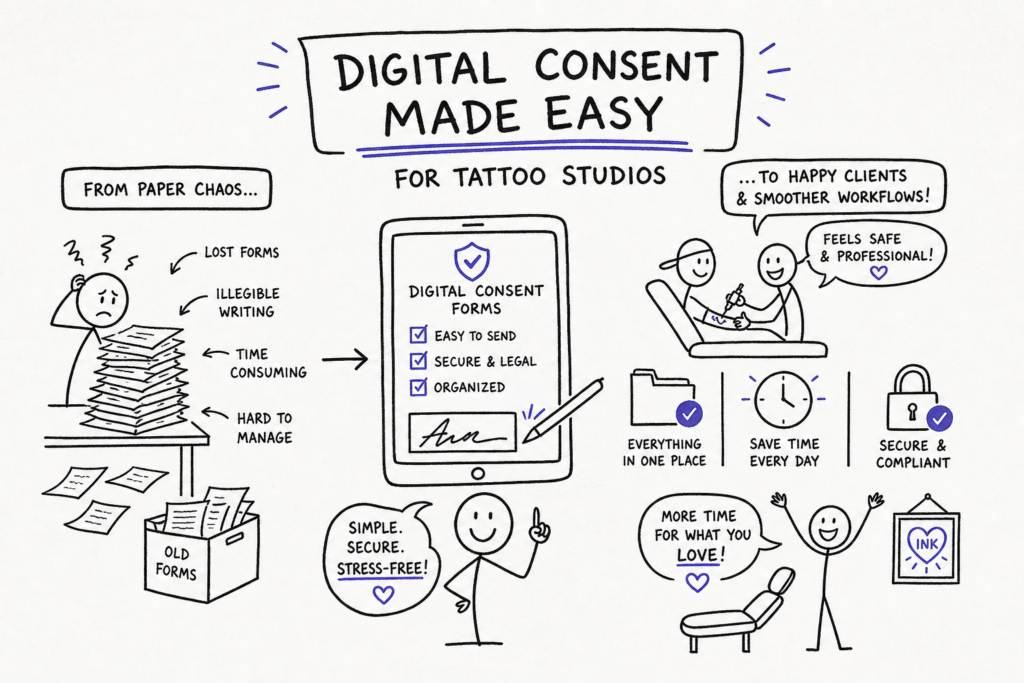
A client walks in, sits down, picks up the clipboard, and spends three minutes filling out a paper form in handwriting their artist can’t read later. No date on the signature line. Medical history section left blank. Sound familiar? Every tattoo studio has this story, and most are still living it. The shift to digital consent form software for tattoo studios isn’t just about going paperless. It’s about protecting your business, accelerating intake, and giving clients a professional first impression before the needle even touches skin.
This guide breaks down exactly what to look for in an electronic consent form app, compares the leading options available in 2026, and shows you how to implement a consent workflow that holds up legally. Platforms like Tattoogenda have started combining consent forms with booking and client history in a single place, which changes how you think about the entire intake process. By the end, you’ll have a clear shortlist and a practical path to implement it.
Why paper consent forms are still costing your studio
The operational friction of paper intake is easy to underestimate until you’re the one digging through a filing cabinet during a health inspection. A health inspector asks for a client’s signed form from 14 months ago. With paper, you’re flipping through folders. With a digital system, it’s a 10-second search by name or date. That difference isn’t just convenience. It’s the difference between passing an inspection confidently and scrambling to explain gaps in your records.
Paper forms also create a compliance gap that compounds over time. Forms go missing. Signatures are undated. Medical history sections get skipped because no one enforces them at the front desk. There’s no audit trail showing who signed what and when, and there’s no way to prove the document wasn’t altered after the fact. For studios operating across multiple artists or locations, the problem scales fast.
The client-facing side matters just as much. A clipboard and pen send a trust signal, just not the right one. When a client books online and receives a pre-appointment form link they can complete on their phone before arriving, that tells them your studio operates professionally. That perception matters when a client is choosing between two equally talented artists. The intake experience is part of your brand.
Why digital consent form software for tattoo studios beats paper
Not all digital form tools understand tattoo intake. A generic form builder gives you blank fields and leaves you to figure out the rest. Good digital consent form software for tattoo studios ships with templates that already include age verification, medical history screening (blood thinners, skin conditions, diabetes, allergies, epilepsy), aftercare acknowledgment, image release, and a liability section. The platform should let you edit those templates to match your studio’s language, add your logo, and create variations for piercing or cosmetic procedures without starting from scratch each time.
The signature is only as strong as the audit trail behind it. A solid platform captures the date, time, IP address, and device used when a client signs. It locks the document after signing so no field can be altered retroactively. Storage should be encrypted, access-controlled, and backed up automatically. This is what separates a platform that holds up during a health inspection from one that just looks clean on a screen.
Walk-in clients are a real part of studio life, and a consent tool that requires a reliable internet connection will fail you on a busy Saturday afternoon. Look for platforms that support iPad kiosk mode with offline signing, sync data automatically when connectivity returns, and don’t require the client to have a smartphone or email address to complete the form. For any shop that handles walk-ins, offline capability is non-negotiable.
Why integration with your booking system changes everything
When your online tattoo waiver tool is separate from your booking system, someone on your team is manually matching signed forms to appointments. That’s wasted time, and it’s also a compliance gap. A form signed last year may not be current for a new session. A returning client might sign under a different email address. A no-show’s form gets tied to a booking that no longer exists. Disconnected tools create disconnected records, and disconnected records are a liability.
The alternative is an intake workflow where nothing falls through the cracks. When consent forms, client history, booking records, and ink passports all live in the same system, intake becomes automatic. A client books online, receives a pre-appointment form link, signs it digitally, and that signature attaches directly to their client profile. By the time they walk through the door, their artist already has their medical history, their last session notes, and their signed waiver on screen. That’s a fundamentally different client experience, and a fundamentally lower legal risk for the studio. For a practical how-to on implementing electronic consent workflows, see E-consent for tattoo studios: go paperless and stay legal.
Top digital consent form software for tattoo studios in 2026
Each platform below has a different strength and price point. Choosing the right one depends on your shop size, whether you need offline signing, and how tightly you want your consent workflow connected to the rest of your operations. The comparison covers four tools across two categories: standalone tattoo e-waiver software and fully integrated studio management platforms.
| Platform | Starting Price | Offline Signing | Booking Integration | Audit Trail |
|---|---|---|---|---|
| eWaiverPro | $25/mo | Yes (kiosk mode) | Via Zapier | Yes |
| Tattoo Release Forms (TRF) | $9.99 (50 forms) | Limited | Limited | Yes |
| WaiverSign | Contact for pricing | Yes | Limited | Yes |
| Tattoogenda | Contact for pricing | Yes | Native (built-in) | Yes |
eWaiverPro
Built specifically for tattoo and piercing studios, eWaiverPro is a waiver-first tool with straightforward tiered pricing: $25 per month for 55 monthly waiver documents, $35 per month for 195, and $60 per month for 495. It includes QR-code signing, ID and photo uploads, lifetime data storage, and a 14-day free trial. The platform integrates with scheduling tools like Acuity and Calendly through Zapier-based connections rather than native ones. It’s a solid fit for smaller studios that want focused tattoo intake form software without committing to full studio management. Check available connection options on the vendor’s integrations page: eWaiverPro integrations.
Tattoo Release Forms (TRF)
TRF is an app-based option with usage-based pricing: $9.99 for 50 forms, scaling up to $54.99 for 400, with an unlimited subscription at $79.99 per month. It works well for studios that prefer app-based tools and have predictable monthly volume. The per-form model can get expensive as your shop scales, and integration with booking systems is limited, which is worth factoring in before committing.
WaiverSign
WaiverSign is a general digital waiver platform that covers tattoo and piercing workflows. It offers customizable templates and standard audit trail functionality. Pricing is not publicly listed and requires direct contact. The platform lacks tattoo-specific fields by default and doesn’t integrate natively with studio booking tools, so it works better as a standalone waiver solution than as part of a connected studio workflow.
Tattoogenda: consent forms built into studio management
Tattoogenda takes a fundamentally different approach. Instead of offering a standalone electronic release form for tattoo shops, it makes digital consent a native part of the studio workflow. Client consent forms are linked directly to bookings, stored in the client’s profile alongside their ink passport and session history, and accessible from any device. There’s no manual matching, no separate login, and no third-party sync required. For studios that want bookings, deposits, reminders, consent forms, and client records all in one place, Tattoogenda is the clear top pick in 2026. The intake workflow runs itself. For a deeper dive into digital waivers and how to choose between standalone and integrated options, see the practical guide to Digital tattoo waivers: the studio owner’s practical guide.
The legal side of electronic tattoo waivers
Under the US ESIGN Act and UETA, electronic signatures are enforceable as long as the client clearly intends to sign, agrees to use electronic records, and the signature is linked to the document with a verifiable audit trail. In the UK, the Electronic Communications Act 2000 supports the same principle. For a UK perspective on whether electronic signatures are legally binding in practice, see this overview: Are electronic signatures legally binding? Across the EU, eIDAS governs electronic signatures at three levels: simple, advanced, and qualified. For tattoo consent forms, a simple or advanced electronic signature is sufficient in most cases. The key is not the type of signature but the proof behind it: who signed, when, on what device, and confirmation that the document wasn’t altered afterward.
The form itself still has to do the legal work. At minimum, every tattoo client consent template (digital) should capture:
- Full legal name and date of birth
- Government ID type
- Medical history questionnaire (allergies, blood thinners, skin conditions, diabetes, epilepsy)
- Risk acknowledgment and aftercare agreement
- Both client and artist signatures
For minors, a separate parental consent section is required in most jurisdictions. Several US states prohibit tattooing minors entirely regardless of parental consent, including California, New York, Georgia, and Illinois. Always verify the rules for your specific state or country before tattooing anyone under 18. If you need starter language or a checklist of must-have clauses, review these Tattoo consent forms: free templates and must-have clauses as a starting point.
An image release clause should be included if you photograph work for portfolios or social media, and it must be clearly optional, not buried inside the risk acknowledgment copy. In the EU, studios storing client health and medical history data are handling special-category personal data under GDPR, which requires explicit consent, strict access controls, encryption, and a clear data retention policy. For practical guidance on handling health data under GDPR and the implications for digital forms, see this overview: Health data and GDPR. Most studios across the US, UK, and EU should retain signed consent records for a minimum of three years, with five to seven years being the safer standard for legal and insurance purposes.
How to choose digital consent form software for tattoo studios
The setup is simpler than most studio owners expect. Pick your platform based on the criteria above, prioritizing tattoo-specific templates and a real audit trail. Build or import your consent form template, and have a local attorney or compliance-savvy colleague review the language for your specific jurisdiction before you go live. Then integrate the form with your booking flow, whether that’s a native connection or a pre-appointment email link, so clients arrive having already signed. Test the full process end-to-end with a colleague before any clients touch it.
Studios that switch successfully share a few habits. They go live with a jurisdiction-reviewed template rather than a generic one. They run a short front desk training session before launch so clients don’t end up on paper forms for the first month by default. And they think ahead about where signed records will live in six months, because choosing a standalone waiver tool without a plan for connecting it to your booking system trades one administrative problem for another. If your consent platform and booking system don’t communicate, you’ve only partially solved the problem.
The right tool makes consent a competitive advantage
The right digital consent form software for tattoo studios depends on what you need beyond the form itself. If you only need waivers, eWaiverPro is an affordable option with solid tattoo-specific features. If you prefer an app-based pay-per-form model and run lower volume, TRF is worth evaluating. But if you want consent forms that are genuinely connected to your bookings, your client profiles, and your ink passports, Tattoogenda gives you that without duct-taping together third-party integrations, and that connected workflow is where the real operational advantage sits.
Whichever tool you choose, the non-negotiables are the same: tattoo-specific templates, a real audit trail, secure cloud storage, and either offline signing or a reliable pre-appointment link flow. Get those right, and your intake process stops being a liability and starts being a professional advantage. Clients notice. Health inspectors notice. Your team will notice the time they get back every single day. For additional reading on sample consent wording and common clauses used by studios, Tattoo Studio Pro’s collection of sample consent forms is a useful reference: Tattoo consent form examples.
Frequently asked questions
Are electronic signatures legally valid for tattoo consent forms?
Yes, in most jurisdictions. In the US, the ESIGN Act and UETA make electronic signatures legally equivalent to handwritten ones, provided there’s a clear intent to sign and a verifiable audit trail. The UK’s Electronic Communications Act 2000 and the EU’s eIDAS regulation apply the same principle. A simple or advanced e-signature is sufficient for tattoo waivers in most cases.
What should a digital tattoo consent form include?
At minimum: full legal name, date of birth, government ID type, a medical history questionnaire, a risk and aftercare acknowledgment, and client and artist signatures. Parental consent is required for minors in most jurisdictions, and several US states prohibit tattooing minors entirely. An optional image release clause should be included separately if you photograph client work.
Can clients sign a tattoo consent form on their phone before arriving?
Yes. Most digital consent form platforms allow studios to send a pre-appointment link that clients complete on any device. This eliminates front-desk delays and ensures the form is signed, dated, and stored before the client walks in.
What’s the difference between a standalone waiver tool and integrated studio management software?
Standalone tools like eWaiverPro handle waivers well but require manual effort to match signed forms to bookings and client records. Integrated platforms like Tattoogenda link consent forms directly to appointments and client profiles automatically, eliminating the administrative overhead and reducing the risk of missing or mismatched records.
How long should tattoo studios keep signed consent forms?
A minimum of three years is standard practice. Five to seven years is the safer benchmark for legal and insurance purposes, particularly in jurisdictions with longer statutes of limitation for personal injury claims.


 English
  Dutch
Dutch  Dutch (Belgium)
  French
  German
  Spanish