
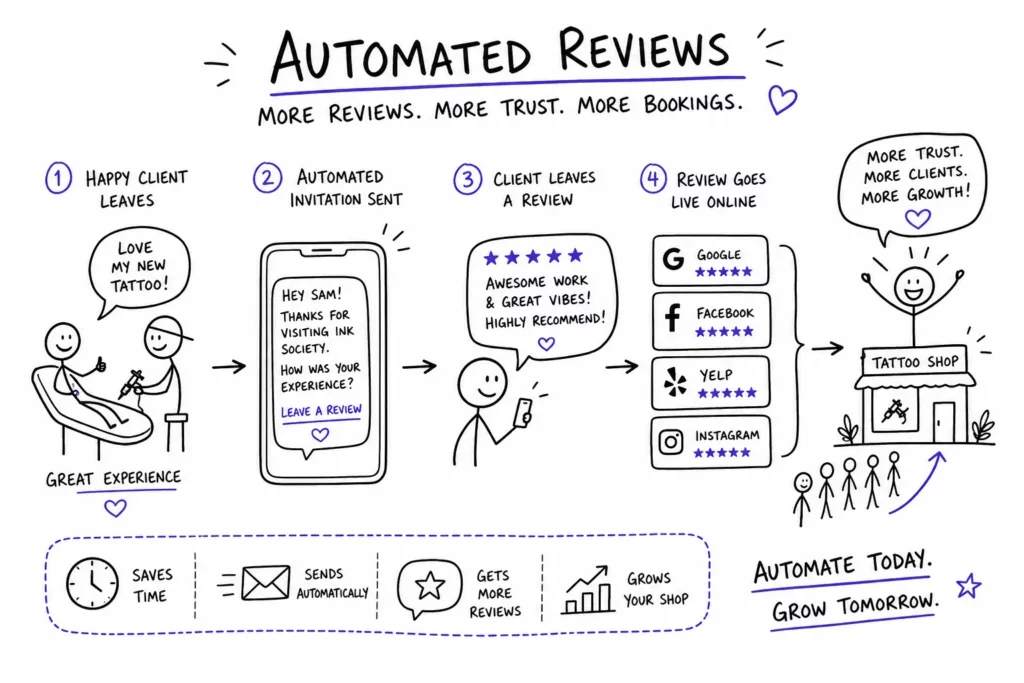
Most tattoo clients walk out of a session on a high. They’re proud of the work, already thinking about who they’re going to show it to, and they’d genuinely recommend your shop to anyone who asked. The problem is, nobody asks. Unless you put a direct link in front of them at exactly the right moment, that enthusiasm quietly fades, and your Google profile stays stuck at the same 14 reviews it had six months ago. That’s precisely why automated review collection for tattoo shops exists: to capture that post-session excitement before it disappears.
Shops that rely purely on word-of-mouth leave their reputation entirely to chance. Meanwhile, studios running purpose-built management software automatically trigger review requests the moment a session closes, capturing client feedback while the experience is still fresh. The gap between those two approaches shows up directly in local search rankings and, more importantly, in new client bookings.
This article walks through exactly how automated review collection works in a real tattoo studio environment: the trigger sequence, which channels convert, message templates that actually get responses, and what the numbers look like after 90 days of running the system consistently.
Why your Google review count determines which tattoo shop new clients book
Google’s local ranking algorithm reads three primary signals when deciding which shops appear in the local pack: review volume, review recency, and average star rating. A shop with 12 reviews from two years ago consistently loses ground to a competitor posting fresh reviews every week, even if the older shop carries a slightly higher average rating. Review freshness signals that the business is active and still delivering quality work right now.
The practical weight of this is significant. Local SEO case studies have documented local pack visibility gains of around 34% and Google Maps call increases near 22% after studios improved review count and recency through automated review requests, though results vary by market and starting baseline. Those aren’t vanity metrics; they translate directly into the number of new clients who find and contact your studio each month. For a deeper look at how reviews impact local SEO rankings, see this practical breakdown.
A common path for new tattoo clients looks like this: Instagram discovery, then a Google search, then a review scan before committing to a booking. Shops with relatively few or stale reviews often lose potential clients at that final step before ever getting the chance to speak with them. Reputation management for tattoo shops isn’t optional marketing; it’s a conversion layer sitting between your social presence and your appointment calendar.
How automated review collection fits into your post-appointment workflow
The trigger: what kicks off a review request
The trigger is the appointment completion event. When a session is marked done inside your studio management platform, the system queues the review request automatically without any staff action required. Nobody on your team has to remember to send a message, copy a link, or follow up manually. The appointment status change handles it.
This connects naturally to other post-appointment touchpoints already running in the system: the aftercare email, the consent form archive, and the client history update. The review request runs alongside those, not separate from them. One automation engine handles the entire post-session sequence, so the client experience feels cohesive rather than a series of disconnected messages arriving from different places. That integration is one reason a modern tattoo shop CRM matters beyond simple scheduling.
The channel sequence: SMS, email, and QR
A multi-channel approach works best because different clients respond to different touchpoints. SMS goes first for speed, email follows as a secondary touchpoint for clients who haven’t responded, and QR codes serve as the in-studio prompt during checkout for clients who prefer to act immediately before they leave.
SMS dramatically outperforms email for review conversion. SMS marketing studies focused on service businesses consistently show completion rates well above email, some reports put SMS response rates around 34% versus roughly 4% for email, though figures vary by industry and message quality. Either way, SMS is the anchor channel for any review automation workflow. For more on converting email contacts into faster responses via text, see this guide on email-to-SMS conversion. Email still matters as a follow-up, but SMS carries the weight.
Timing automated review collection for tattoo shops
The optimal send window after a tattoo session
Send the first SMS within one to four hours of the appointment ending. The experience is fresh, the client is still excited, and they haven’t mentally moved on to the rest of their day. This is the window where the emotional connection to the work is strongest and where a simple ask converts most reliably.
Shops that wait 24 to 48 hours to send a review request are working against themselves. The excitement fades fast, especially after a longer session when aftercare discomfort starts to set in. A client who would have happily left a five-star review four hours after their appointment may not feel like engaging with anything the next morning when they’re wrapping a sore forearm.
When to follow up and when to stop
A two-touch sequence is the right ceiling: the initial SMS within four hours, followed by one follow-up via email or a second SMS within 24 hours if there’s no response. That’s the complete sequence, anything beyond it erodes goodwill fast.
Tattoo clients are not subscription prospects, and treating them like one will damage the relationship. Over-requesting creates friction, and that friction can color the review itself if the client does eventually respond. One polite nudge and one reminder is the pattern that converts without alienating people who’ve just trusted you with permanent work on their body.
Message templates that get tattoo clients to actually respond
What makes a review request SMS convert
Response rates hinge on a short, personalized message with a one-tap link directly to the review page. Generic “please review us” messages get ignored because they feel automated and impersonal. A message that references the client’s name and the specific work done feels like a follow-up from someone who actually paid attention, and that’s what earns the click.
In practice, the variables that move response rates most reliably are the client’s name, a service-specific reference, and sending the message while the appointment is still fresh. Keep the message under 160 characters when possible; every extra sentence is another reason not to act.
SMS and email template structures worth using
For SMS, this structure works well in practice:
- SMS (primary): “Hi [Name], thanks for coming in for your [piece/session type] with [Artist]. If you have 60 seconds, a review would mean a lot: [Link]”
- Email subject line: “How was your session?”
- Email body: One sentence of genuine thanks referencing the specific appointment, one clear CTA button pointing directly to the Google review page, nothing else.
The single-ask rule matters more than most studio owners realize. The review request message should do exactly one thing. Don’t combine it with an upsell, a referral ask, or aftercare instructions in the same message. When you stack multiple asks into one communication, clients respond to none of them. Give the review request its own space and it converts; bury it with other content and it disappears. For practical industry tips on crafting effective SMS review requests, check out this piece on best practices for SMS review requests.
How Tattoogenda builds automated review collection into your booking workflow
Review requests as part of the automated post-appointment sequence
Tattoogenda’s post-appointment automation runs the review request as part of the same sequence that handles aftercare emails, consent form archiving, and client history updates. The review ask isn’t treated as an afterthought; it’s wired directly into the workflow from appointment close. When an artist finishes a session and marks it complete, the client receives the review request via SMS or email without anyone on the team doing anything manually.
This matters because consistency is what builds review volume over time. Studios that rely on staff to manually send review requests get inconsistent results based on who’s working, how busy the day was, and whether anyone remembered. Automating the sequence removes that variability entirely. Every completed appointment triggers the same professional follow-up, regardless of day, time, or which artist ran the session.
Connecting review collection to client records and Google presence
Tattoogenda’s CRM is built to connect client records to post-appointment outcomes, giving studio owners visibility into which segments of their client base are engaging with review requests. That kind of data changes how owners manage their reputation strategy. Instead of guessing whether the review request is working, you can see exactly where traction is coming from and which part of the workflow is converting. For shops focused on gathering more feedback, integrating feedback management software into the process can boost review volume and quality.
If one artist’s clients are reviewing at a high rate and another’s aren’t, that’s a signal worth investigating: different client demographics, different session lengths, different communication styles. The platform surfaces the pattern; the owner decides what to do with it. That’s the difference between a reputation that grows by accident and one that grows by design. For teams that regularly host outside talent, a clear guest artist booking workflow helps keep expectations and follow-ups consistent across everyone on the roster.
Automated review collection best practices for tattoo shops: measuring real impact
What realistic results look like in the first 90 days
Shops running client feedback automation for tattoo parlors typically see 20% to 30% of new clients leave a review, with some implementations reaching above 50% for new customers. Reactivation campaigns sent to past clients tend to convert at around 10% to 15%. Those numbers may seem modest until you do the math on a real schedule.
For a shop doing 80 appointments per month and assuming a 20% conversion rate, that’s roughly 16 fresh reviews every month, nearly one per day at 30%. As an illustrative example: a studio starting with 14 reviews and sustaining that pace could surpass 100 reviews within six months, with a consistent stream of recent ones signaling to Google that the business is active. That shift in review velocity is what moves a studio up the local pack. The balance between review recency vs. quantity is an important factor to watch as you scale volume.
Tracking whether reviews are driving new bookings
The attribution chain runs through Google Business Profile insights: watch searches, map views, and website clicks alongside the review count trend. When review velocity increases, local search visibility typically follows within 60 to 90 days. The connection isn’t instant, but it’s reliable.
Ask new clients during intake how they found the shop. That single data point, collected consistently at every consultation, closes the loop between review automation for tattoo studios and actual revenue. If the share of new clients citing Google search starts climbing in the same period that review volume increases, you have real evidence of the system working, not just better-looking metrics on a dashboard.
Building a review system that actually sticks
Automated review collection for tattoo shops isn’t about gaming the system. It’s about capturing feedback that clients are genuinely ready to give, at the exact moment they’re most likely to act on it. The work to earn that feedback is already done; the session is finished, the client is happy, and the only thing standing between you and a five-star review is whether you asked at the right time in the right way.
What makes it work is consistency, and consistency requires automation. Trigger on session completion, lead with SMS, keep the message personal and brief, cap the sequence at two touches, and track the results at the artist and session-type level. None of that is complicated, but none of it happens reliably without a system behind it.
Tattoogenda has this workflow built in from the ground up, so your artists can stay focused on the work while the platform handles the reputation-building in the background. If your studio is still relying on someone remembering to send a text, it’s worth seeing how much that’s been costing you. Start a free trial with Tattoogenda and run the automated review sequence on your next 30 appointments. The difference in your review count will tell the rest of the story.
Frequently asked questions about automated review collection for tattoo shops
How soon after a tattoo appointment should a review request be sent?
The sweet spot is within one to four hours of the session ending. At that point the client’s excitement is at its peak, aftercare discomfort hasn’t set in, and the ask feels timely rather than intrusive. Waiting until the next day consistently produces lower response rates.
How many review request messages should a tattoo shop send?
Two touches is the right limit. Send the initial SMS shortly after the appointment, then one follow-up via email or SMS within 24 hours if there’s no response. Beyond that, you risk irritating clients who’ve just trusted you with permanent work, and that friction can show up in the review itself.
Does automated review collection work for both new and returning tattoo clients?
Yes, but conversion rates differ. New clients going through a full post-appointment sequence tend to review at 20% to 30%. Reactivation campaigns targeting past clients who haven’t visited recently typically convert at 10% to 15%. Both are worth running; the new-client sequence just carries more weight in total volume for an active shop.
Which platforms should tattoo shops direct clients to for reviews?
Google is the priority because Google reviews directly influence local pack rankings and Maps visibility. Yelp and Facebook are useful secondary platforms, particularly for shops in markets where those channels still drive discovery. In most cases, the review request SMS should link directly to the Google Business Profile review page to minimize friction.

 English
  Dutch
Dutch  Dutch (Belgium)
  French
  German
  Spanish