
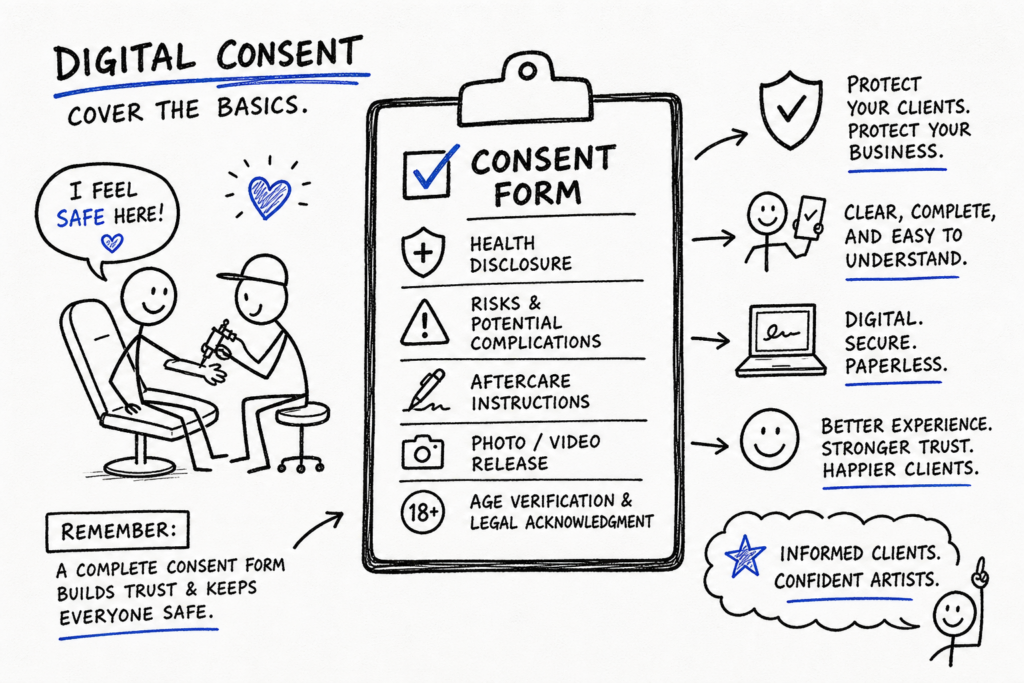
A client calls six months after their session and claims no one ever warned them about allergic reactions to pigment. You reach for their file. The paper form is gone, possibly discarded during a studio clean-up, possibly never filed properly in the first place. That single scenario is exactly why a well-built digital consent form is not optional. It is the document that stands between your studio and a costly dispute, and a missing or incomplete one leaves you with nothing to stand on.
If you are asking what should a tattoo studio include in a digital consent form, this checklist covers every required section: client identification fields, health disclosures, legal release language, age and ID verification, e-signature validity, and secure storage. Whether you are building your first digital tattoo waiver or updating a version that has not been reviewed in years, you will leave with a clear picture of what “complete and defensible” actually looks like. Studios using Tattoogenda get a head start here, since the platform ships with customizable, industry-specific consent form templates that slot directly into the booking workflow.
What should a tattoo studio include in a digital consent form, core fields
Identification fields
Every consent form starts with client identification: full legal name, date of birth, address, phone number, email, and an emergency contact. These fields do more than identify the person, they establish a verifiable record tied to a specific session. Attorneys and insurers will commonly request identity and contact information early in a dispute, which makes these fields foundational rather than administrative.
Health disclosures
The health disclosure section is among the most legally significant parts of a tattoo studio intake form, particularly when informed-consent challenges arise in litigation. Vague language here creates real gaps. Ask specifically about allergies to metals, latex, adhesives, and pigments. Medications that affect clotting or healing, blood thinners in particular, should be listed by name. Include pre-existing conditions like diabetes, hemophilia, skin disorders, seizure history, and a history of fainting. Each question should require a yes/no response with a space to explain any “yes” answer, rather than leaving clients to volunteer information on their own terms. For a practical checklist of these fields, consult our detailed guide to consent forms in a tattoo studio.
Pregnancy and immune status
Pregnancy, nursing status, and immunocompromised conditions deserve their own clearly labeled fields rather than being buried inside a general health section. Ask directly: is the client pregnant, possibly pregnant, or nursing? Do they have any condition affecting their immune response? These disclosures are commonly implicated in post-session medical complaints, so they need to be unambiguous and separately acknowledged by the client at the point of signing.
Legal clauses that actually protect your studio
The informed consent and assumption of risk language needs to state clearly that the client is participating voluntarily, understands the inherent risks of tattooing, infection, scarring, allergic reactions, and accepts those risks knowingly. U.S. courts in contract disputes specifically look for “knowingly and voluntarily” language. Generic risk language that does not name actual outcomes tends to fail when challenged. Courts have found generic risk language unenforceable when it fails to expressly name negligence as a covered claim, so that explicit mention is not optional.
A defensible release clause names the studio, its owners, employees, and agents, and explicitly includes claims arising from negligence. Ambiguity is a liability in itself: if the clause does not clearly say “negligence,” some courts will not read it in. Pair the release with a hold-harmless and indemnity clause that covers attorney’s fees and damages. Keep these as separate, clearly labeled sections rather than buried inside a dense paragraph of legal boilerplate.
Photo release and aftercare acknowledgment both belong on the form, but treat them as distinct sections. The photo clause should state consent to capture and use images for promotional and operational purposes. The aftercare acknowledgment should confirm the client received written instructions, had the opportunity to ask questions, and understands that following those instructions affects the outcome. Neither section should be drafted as a waiver of gross negligence, state courts have often refused to enforce waivers covering gross negligence or conduct against public policy, and attempting it can undermine the credibility of the rest of your form.
Age verification and parental consent requirements
There is no single national standard in the United States. Most states set the minimum tattoo age at 18, but the rules diverge significantly from there. California prohibits tattooing minors regardless of consent. Florida allows it for ages 16 to 17 but requires notarized written consent, in-person guardian presence, government-issued ID from both the minor and guardian, and proof of guardianship. Delaware requires notarization. Alaska, Arizona, and Pennsylvania require the guardian to attend the session. Because these requirements are defined by individual state statutes and local licensing rules that can change, always verify the current law in your jurisdiction before relying on any specific detail. A regularly updated summary of tattoo laws by state is a good starting point when checking local requirements. Build your form to the strictest rule that applies to you, not the most lenient one you can find.
The parental consent section should capture the parent or guardian’s full legal name, their relationship to the minor, their government-issued ID number and type, their signature, and the date. Where notarization is required, the form must include a notary acknowledgment block. Build in a checkbox confirming the guardian was physically present if your state requires it. Store a copy of the ID alongside the signed form so the documentation chain is complete. For practical templates and a state-focused digital consent checklist, see this state-by-state compliance guide for digital consent forms, and if you need templates and e-sign best practices, check our online consent form: tattoo client templates & e-sign tips.
ID verification is your primary defense against forged consent. Train staff to check ID for both the client and, for minors, the guardian. Note the ID type and number on the form or in the client profile. Tattoogenda allows studios to attach ID documentation directly to the client’s digital record, keeping the proof of verification permanently tied to the consent form rather than sitting in a separate folder that can be misplaced.
E-signatures: are they legally valid for tattoo waivers?
In the United States, the ESIGN Act and UETA establish that electronic signatures are legally valid for the vast majority of contracts and consent documents. For an informed consent tattoo form, an e-signature holds up if the client intended to sign, consented to transact electronically, and the signed record can be stored and reproduced accurately. In the EU, eIDAS governs electronic signatures across member states; a standard electronic signature is generally sufficient for a tattoo consent form unless local law requires a higher assurance level. The key point for studios: e-signatures are valid, but the underlying state or national rules around age, notarization, and guardian presence still apply regardless of how the form is signed. For an accessible primer on the legal status of electronic signatures, see Clio’s overview of electronic signature legality.
For the signature to be defensible, the signed form must be locked after signing so the content cannot be altered. A time-stamped audit trail showing when the form was sent, opened, and signed is the difference between a solid record and a disputed one. The system should link the signature to the signer’s identity, ideally through an email or SMS verification step. Collecting the IP address and device information at the time of signing adds another layer of documentation that holds up under scrutiny.
Tattoogenda’s digital consent forms handle this automatically. The platform sends forms before appointments, captures e-signatures with a full audit trail, and stores the completed documents in the client’s profile. Studios can customize every field to match their local legal requirements without starting from scratch. The consent form becomes part of the booking workflow, not a separate step the client forgets or the studio loses between sessions.
Storing and managing your consent forms compliantly
Signed consent forms contain sensitive health information, which means storage security is not a preference. Forms should be encrypted both in transit (TLS) and at rest (AES-256 is the widely accepted standard for data at rest, consistent with guidance from security frameworks such as NIST). Access should be role-based: front desk staff may need to confirm whether a form is complete, but only artists and managers should access the health disclosure content. Multi-factor authentication for administrative access is a baseline security expectation, and every access or modification event should generate a time-stamped log.
For retention, a practical benchmark is three to six years tied to the applicable statute of limitations in your jurisdiction, though some studios apply a ten-year standard for informed consent records as a conservative measure. Under GDPR, studios collecting health data from EU clients must document the legal basis for processing, explain how data is stored and who accesses it, and maintain a clear deletion policy when the retention period ends. CCPA-covered studios in California need to define and document their retention periods, align the consent form process with their privacy notice, and be prepared to honor client data-access and deletion requests.
The practical takeaway: document your retention period, automate deletion or anonymization at the end of it, and verify that your platform’s data handling meets the legal standard for every jurisdiction you operate in. Studios using Tattoogenda benefit from a system built around secure, structured record-keeping, with the consent form, client health history, and session records all stored together and accessible under proper access controls.
Integrate consent into your booking workflow, not your check-in line
A consent form handed over at the front desk while a client is filling out intake paperwork is not an informed consent process. It is a signature-collection exercise. The client has not had time to read it, ask questions, or consider the health disclosures seriously. That dynamic weakens the form’s defensibility and creates the impression of a studio that treats consent as a formality rather than a genuine process.
The best workflow sends the form at the point of booking, with a reminder 24 to 48 hours before the appointment. When the client signs, the completed form attaches instantly to their appointment and client profile. The artist sees the health disclosures before the session starts. There are no missing forms on the day, no chair-side scramble, and no situations where a client is rushed through a document they should read carefully.
A digital consent form built into the booking process is not extra work, it is less work, with far better documentation to show for it. That covers what should a tattoo studio include in a digital consent form: start with the checklist above, adapt it to your jurisdiction’s specific requirements, and make sure every client signs before the needle touches skin. If you want a faster starting point, Tattoogenda’s consent form templates are built for exactly this workflow and ready to customize for your studio today. For additional sample wording and printable templates, see Vagaro’s tattoo consent form resource.
 English
  Dutch
Dutch  Dutch (Belgium)
  French
  German
  Spanish
Pingback: Electronic consent forms for faster studio check-ins