
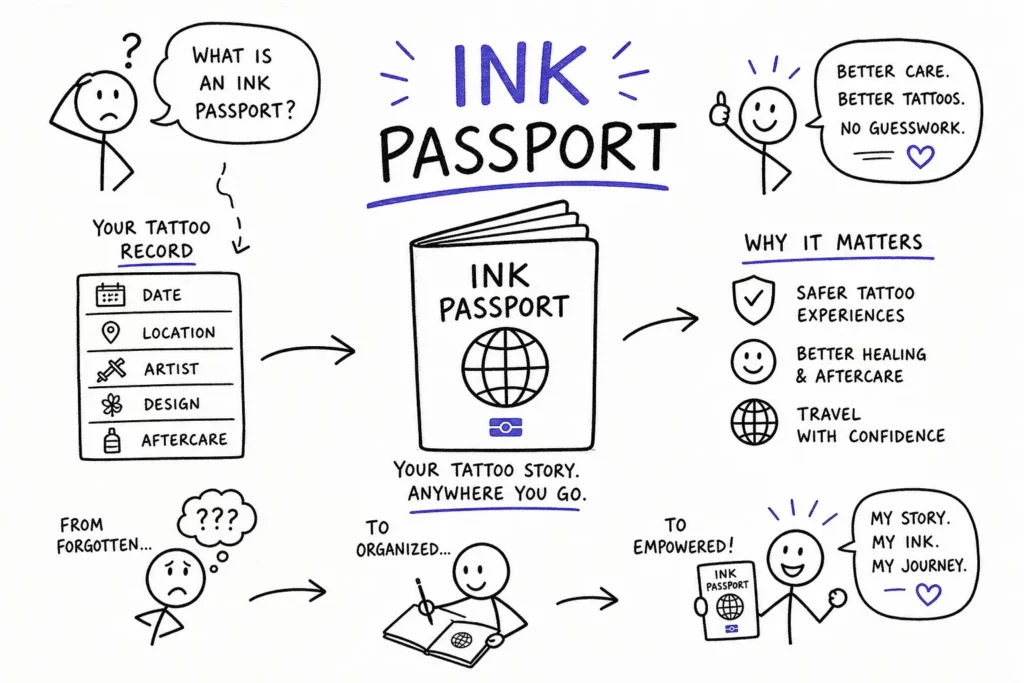
Picture this: you’ve just moved to a new city, found a great artist, and you’re sitting in for a consultation on your next piece. The artist looks at your existing work and asks a reasonable question: what inks were used in that sleeve? You have no idea. You remember the studio, maybe the artist’s name, but the specific brands, the batch numbers, the color codes? Gone. That gap between getting tattooed and actually knowing what went into your skin is exactly what an ink passport solves.
An ink passport is a permanent digital record of every tattoo session a client has had, capturing the inks used, needle details, aftercare notes, and the artist involved. It is not a novelty or a nice-to-have. It has real health implications, helps future artists make better decisions, and turns a collection of isolated appointments into a coherent, lifelong history. Platforms like Tattoogenda treat client documentation as a core feature of studio management rather than an administrative afterthought, and understanding what that record contains is worth your time.
What an ink passport actually is
An ink passport is not a physical booklet, and it is not a government document. It is a structured digital record, tied to a specific client, that documents what happened during a tattoo session: which inks were used, which needles, and by which artist. Think of it as a medical chart for your skin art. Each session adds a new entry, and over time the record becomes a complete history of every piece you have had done.
The concept has roots in European health and safety regulation. EN 17169:2020, a standard covering safe and hygienic tattooing practice, requires tattoo professionals to document exact ink data, including blue-black ink, passport-style color codes, and LOT numbers, for every appointment. That standard pushed studios across Europe to formalize records they had previously kept informally or not at all, and the concept has since entered broader tattoo culture as a best-practice client record, regardless of geography. In the United States, regulation is handled at the state and local level rather than federally, which means requirements vary widely and many clients in states without formal mandates never receive a copy of their own session data.
It is also worth separating an ink passport from an aftercare sheet. A printed list of care instructions is not an ink passport. A true ink passport is a digital record stored in a client profile, accessible across sessions, and built to persist for years. The difference between those two things is significant.
What a complete ink passport contains
Ink data
A proper ink record goes well beyond “we used black and grey.” It documents the brand name, color code, batch number, LOT number, supplier, and expiration date of every ink used in a session, from vivid saturated pigments to blue-black ink used for fine linework. The LOT number matters more than most clients realize. If a health alert or product recall is issued for a specific ink batch, a client with a documented record can check their history immediately rather than guessing whether they were affected. Apps and platforms designed around this concept, sometimes called passport ink trackers or INKpassport-style tools, make that lookup instant rather than dependent on a studio’s internal files.
Session notes
Beyond ink data, a complete record includes the session date and studio location, the artist’s name and contact information, the body placement, and personalized aftercare instructions based on what was actually done in that sitting. These notes are specific, not generic. A piece on a rib heals differently than one on the forearm, and a studio that documents those recommendations is giving the client something worth keeping.
Photos and timeline
A thorough ink passport also grows over time. Each new session adds a layer to the record, including reference photos of the completed work. Over years, this becomes a visual and clinical timeline: where you started, which artists have contributed, what products have gone into your skin, and how each piece healed. That kind of history is genuinely useful, and many tattooed people currently have none of it.
Why having one matters more than most clients realize
Tattoo ink reactions are more common than most people expect. According to research published in journals including Contact Dermatitis, allergic reactions affect somewhere between 2 and 6 percent of tattooed individuals, with some cohort studies finding that up to 10 percent experience significant skin responses. What makes this complicated is timing: reactions can surface years or even decades after the original session, long after any aftercare card has been lost and any verbal instructions forgotten.
A dermatologist evaluating a delayed hypersensitivity reaction needs specific data: the ink brand, the pigment type, ideally the LOT number. An ink passport delivers that information immediately. Without it, a client is left describing what they can remember, and the doctor is working with incomplete information. Red inks are the most frequent source of reactions due to their common pigment compounds, but responses to green, yellow, blue, and black inks are all documented. The specific ingredient matters, and knowing it changes how a reaction is diagnosed and treated.
Planning future sessions is also more straightforward with a complete record in hand. When a client books a touch-up or an extension piece with a different artist, that artist needs to know what inks are already in the skin to match colors accurately and avoid layering incompatible products. Without that context, they are working blind. With a documented history, the consultation starts from an informed position, not from guesswork.
Client relationships end for many reasons, an artist relocates, a studio closes, a client wants a fresh perspective. An ink passport means none of that history disappears, and a new artist can pick up exactly where the last one left off with full context about what has already been done.
The gap between what studios track and what clients actually receive
Many professional studios track some session data internally. The issue is that it stays internal. A client who leaves a studio, for any reason, cannot access that data. They walk out with an aftercare sheet and whatever they remember from the appointment. The studio retains the record; the client retains nothing.
This gap is not primarily a question of negligence, it is a workflow problem. Building a proper client record, one that includes ink data, aftercare notes, consent history, and session photos, takes time. When documentation is a separate manual task sitting outside the main booking and intake process, it gets deprioritized under real operational pressure. A busy studio with multiple artists running back-to-back sessions does not have spare capacity for paperwork that feels disconnected from everything else.
The result is predictable. Verbal aftercare instructions replace written records, and ink data sits in a supplier invoice rather than a client file, leaving clients to start from scratch every time they switch studios or return after a few years. The tattoo industry is skilled and creative. Its documentation habits have not always kept pace with the quality of its work.
How studios build ink passports into their workflow without extra paperwork
The key insight is that an ink passport should not be a separate task. It should be a natural output of processes the studio is already running, specifically the consent form and client intake workflow. When ink data is captured as part of booking and consent rather than as a standalone admin task, it does not add time to the process; it replaces redundant steps that were already happening.
This is where Tattoogenda fits in directly. Tattoogenda is a studio management platform designed with the documentation problem in mind. Ink records in Tattoogenda are not an add-on or a separate module, they are built directly into the client profile and consent form workflow. When a client books, fills out their digital consent form, and completes their session, the ink record is populated as part of that process and stored in their profile. The studio does not create a separate document. It is already done.
What this enables on the client side is significant. Studios using this kind of integrated workflow can send clients their complete session record as a PDF by email immediately after the appointment. No extra steps required. For the client, that changes the experience entirely: instead of leaving with a generic aftercare card, they leave with a documented record of exactly what went into their skin, who did it, and what to do next. That is a measurable difference in professionalism and client trust.
How to get your ink passport started
The simplest first step is to ask your current or next studio directly whether they maintain ink records and whether they share that information with clients after a session. Some studios already have this capability and simply do not advertise it. Asking makes it clear that you value professional documentation, and it gives studios using integrated platforms an easy opportunity to demonstrate what they offer.
If your studio does not have a system in place, you can begin building your own record. Request the ink brand and color details, including the passport signature color or color code if available, at the end of your next session, photograph the completed work, and store everything in a dedicated folder. It is not as seamless as an integrated system, but it starts the habit and gives you something to build on.
- Ask your artist for the ink brand and color codes used in each session
- Photograph the completed work the day it is done and again after healing
- Note the studio name, artist, date, and body placement in a consistent format
- Store everything in one place, whether that is a cloud folder or a dedicated app
For clients actively looking for a new studio, especially after a move or a change in preference, choosing one that uses purpose-built management software is worth factoring in. A studio running an integrated platform treats your first session as the start of a proper record, not another isolated appointment that disappears from your reach the moment you walk out the door. If you want to learn more about going paperless with intake and consent, see this practical guide on e-consent for tattoo studios.
The record your skin deserves
An ink passport is a lifelong digital record that every tattooed person deserves access to, not just for compliance reasons, but for real health benefit and practical continuity across a lifetime of sessions. The tattoo industry is evolving, and the studios leading that change are the ones treating client documentation as a feature of the service, not as a regulatory burden.
The technology to do this already exists without adding administrative load. When ink records are built into the consent form and client profile workflow, as they are in platforms like Tattoogenda, every session ends with a client who has a complete record and a studio that has done right by them. No extra forms, no parallel systems, no guesswork.
When was the last time you left a tattoo session knowing exactly what went into your skin? If the answer is never, it might be time to find a studio that has that system in place.

 English
  Dutch
Dutch  Dutch (Belgium)
  French
  German
  Spanish