
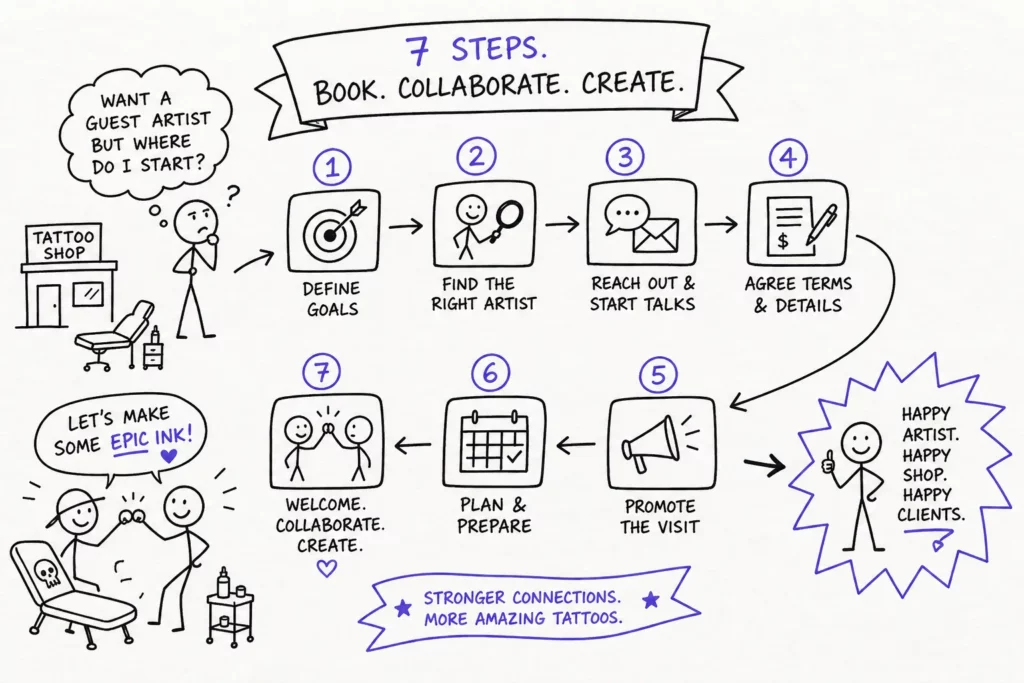
A guest artist rolls in, the calendar is half full, the contract lives in a text thread, and the split gets settled with a handshake at close. You know how that story ends: missed revenue, messy expectations, and a talented person who never returns. The shops that fill every seat and earn repeat visits share one thing in common, they run a clear, repeatable guest-spot system every time.
This 7-step guest artist booking workflow for tattoo shops breaks the flow into practical moves, from the first inquiry to the last follow-up after the visit ends. You will publish a clean intake, vet properly, lock the calendar, lock the deal, manage client bookings, run promotion that converts, then close the loop. Shops using a platform built for tattoo operations, like Tattoogenda, have an advantage because the entire routine can live in one place. If you are not there yet, this article shows exactly what to build and how to run it.
Why most guest spots fall apart before the first tattoo
The real cost of winging it
Chaos compounds when there is no plan. Day one opens with two empty session blocks, a no-show on the afternoon, and a deposit that was never collected because the client only DMed. The guest forgot to send BBP and insurance, so front desk scrambles while clients wait. You lose the seat, you lose time, and you lose trust.
The financial hit is obvious, but the reputation cost lingers. The guest goes home and tells peers it was disorganized, and clients sense the friction, which erodes confidence and reviews. A sloppy guest spot can undermine months of careful brand building, so prevention beats damage control.
What a clear process actually protects
A documented routine protects the shop, the guest artist, and your clients. It reduces back-and-forth, sets expectations early, and creates a consistent client experience so there are fewer surprises and fewer exceptions. The seven steps below are designed to prevent the most common failures by centralizing intake, formalizing terms, locking availability, enforcing deposits, and automating reminders, the foundation of a week that runs smoothly and profitably.
Steps 1-2: Build a guest-artist submission process and vet artists
1. What your guest artist submission form needs to cover
Your submission form is the front door. Replace scattered emails and DMs with a single form that captures everything you need to make a fast, confident decision. Standardized intake filters out anyone not willing to complete the basics, and it gives your team one reliable record to work from. If it is not on the form, it is not in the pipeline.
- Full name, email, phone, and home studio
- Portfolio link plus two or three social handles
- Style specialties and minimums
- Preferred visit dates and total days available
- Licenses held, BBP certification date, and insurance status
- Any equipment or supply needs, and expected rate
Publish the form on your site and link it in a pinned social post, then route all inquiries there. In practice, shops book faster and drop fewer details when every request goes through one channel instead of fragmented DMs and emails.
2. Licenses, BBP certification, and insurance: what to require
Before a single appointment gets booked, require three non-negotiables: a valid tattoo license or registration, current bloodborne pathogen training, and proof of liability insurance. Some regions require a temporary or guest registration locally, so include a line in your approval email that lists the exact permit the guest must hold on arrival. Your policy should state that files must be on record before booking opens.
Ask for a government-issued photo ID as part of your file, and note any optional extras your shop prefers, like CPR or first-aid. This protects your studio legally and signals a professional operation. It also saves front desk time, since your team will not chase documents in the middle of a rush.
If you need guidance on local licensing and how shops typically handle credential verification, resources that explain how to get a tattoo license can help you build a clear checklist for applicants.
Steps 3-4: Lock the schedule and finalize the guest-artist agreement
3. Setting up the calendar window and blackout dates
Define the exact start and end dates of the guest spot, then publish the artist’s bookable hours inside that window. Everything outside those hours should be blocked in your scheduling system, and your front desk should see an obvious appointment lock so they cannot accidentally offer those times. Limited availability creates urgency, but only if the limit is real and enforced. For more on coordinating availability across your team, see Managing booking appointments across your tattoo shop team, tattoogenda.com.
A common mistake is leaving the calendar open-ended, which invites requests you cannot honor. Use clear labels in the artist profile and on your booking link: “Guest visit: June 14, 18 only.” It sets expectations and keeps the inbound clean.
4. Payment splits, deposits, and cancellation terms
The agreement should be written, short, and signed. Cover the split or fee structure, deposit rules, cancellations, length of stay, shop rules, supplies provided, tax responsibility, and who handles client messaging. Percentage splits vary by studio and arrangement; many shops run a 70/30 or 60/40 artist-to-shop split, with some using a flat booth fee. Treat published examples, like a shop taking 30 percent, as just that: examples. Set your terms based on your market and costs.
Use a copy-ready clause block: Split: [shop % / artist %] paid daily or at checkout; Client deposit: [amount or %], collected on booking, applied to the final total, non-refundable inside [X] days; Guest hold deposit: [optional amount] to reserve dates; Cancellation: reschedules allowed with [X] days’ notice, deposits forfeited for late changes or no-shows; Length of stay: [start date] to [end date], with any extension approved in writing; Communication: shop or artist leads client messaging as assigned. Clear, simple text prevents awkward conversations later.
If you want to remove manual friction around deposits, check out How to automate deposit collection for your tattoo studio to see a practical approach shops use to enforce and record client deposits.
Step 5: Manage client bookings during the guest visit
5. Client intake form and consultation flow
Route all client interest through a brief intake form, then confirm or decline quickly. Capture name and contact, placement and size, style preference, reference images, and health-relevant details like allergies or healing concerns. This qualifies the client before the consult and gives the guest artist context for pricing, timing, and design prep.
Tie intake to your digital consent flow so paperwork is signed in advance, not at the chair. With a studio CRM, the client’s intake, consent form, and ink passport live in one record the guest can review the night before. Preparation is the easiest way to buy back time on a limited schedule. If you need examples to model your form after, see these client intake form examples.
5. Automated reminders, blackout dates, and rescheduling rules
Send SMS and email reminders two to three days before the appointment, with a one-tap confirm button. Automated reminders are among the most effective ways to cut no-shows; research in appointment-based settings shows reminders significantly improve attendance rates (Cochrane Review). If clients need to reschedule, route them through the same system and mirror your shop’s standard rules. For practical tactics studios use to reduce no-shows, review best practices for avoiding no-shows.
Keep the calendar guardrails tight. Blackout dates should be locked so staff cannot place a booking outside the visit window. If the guest is in town for only five days, your system should respect that hard stop across online booking, front desk, and any manual edits.
Steps 6-7: Fill the calendar and follow up after the visit
6. Promotional tactics that actually convert
Social posts drive awareness, but they rarely close the deal alone. The highest-converting flow is consistent and direct: show the work, repeat the dates, then put a clear booking link in front of people who already care. Email and SMS lists often outperform feed posts for conversions because you can follow up.
- Announce the guest spot with dates, styles, and a booking link.
- Capture interest into email or SMS from your bio and Stories.
- Send a short sequence: announcement, reminder, “spots filling,” final call.
- Offer pre-sale deposits to hold a time for warm leads who are not ready to finalize.
Use urgency honestly: limited seats and a countdown to booking close. Include three to six strong images or a short process video, plus one clear call to action. Remove friction at every step.
7. Post-visit follow-up that builds long-term value
After the visit, send a personal message to each client. Thank them, link aftercare, invite a review, and note when the artist is likely to return. This closes the loop and captures social proof while the experience is fresh.
Then debrief with the guest: share booking performance, ask what made the week smooth or bumpy, and extend a standing invitation with tentative dates. Turn one good week into a recurring guest-spot rhythm so your shop becomes a destination for visiting artists.
How to automate this guest artist booking workflow with Tattoogenda
From submission form to checkout, all in one place
Tattoogenda is designed for tattoo and piercing studios and aligns well with this seven-step system. You can centralize guest-artist applications, track required documents, set a defined calendar window with blackout dates, and share a booking link that reflects limited availability, all in one place.
For payments and deposits, keep a single, consistent method across channels. Whether you handle deposits and balances through your POS, a connected processor, or within your studio software, record them against the client’s booking so application at checkout is straightforward. Automated SMS and email reminders, digital consent, client history, and ink passports should live in the client record the guest can review before they walk in. If you want to turn that into a repeatable routine, Build a tattoo studio deposit workflow that runs itself.
Building a workflow you can repeat every time
The goal is not to survive one guest spot, it’s to build a system the entire team can run without asking what comes next. In Tattoogenda, submissions, scheduling, agreements, client bookings, reminders, and follow-ups can become your default routine.
Assign roles, set approval steps, and reuse the same templates for every visiting artist. Consistency scales everything that works and starves everything that does not. New guest artists get the same professional experience as the last, and your reputation attracts stronger applications over time.
Guest-artist scheduling checklist you can copy
- Publish your guest-artist submission form and route all inquiries there.
- Approve only after you have license/registration, BBP certificate, insurance, and ID on file.
- Lock the calendar window, block everything else, and label availability clearly.
- Send and sign a short agreement: split or fee, deposits, cancellation, stay dates, studio rules.
- Open client intake with deposit collection: set 25, 50 percent or one hour of rate for guest bookings.
- Run the promo sequence with a single booking link and pre-sale holds for warm leads.
- Automate reminders, collect consent before day one, then follow up for reviews and rebooks.
Schlussfolgerung
The difference between a chaotic guest spot and a profitable one is almost always process, not talent. The seven steps work as a single system: submission, vetting, scheduling, agreement, client booking management, promotion, and follow-up. When you treat each step as a standard, not an exception, your calendar fills and your guest artists come back.
If you want this to run with minimal lift, Tattoogenda ties it together in one place: forms, file tracking, limited availability, deposits, automated reminders, consent, and client history. Start your next guest-artist booking on firm ground, open your submission form in Tattoogenda and make the next visit your smoothest yet. For a deep dive on how to automate deposit collection for your tattoo studio, the platform guides are a good next step.

 English
  Dutch
Dutch  Dutch (Belgium)
  French
  German
  Spanish