
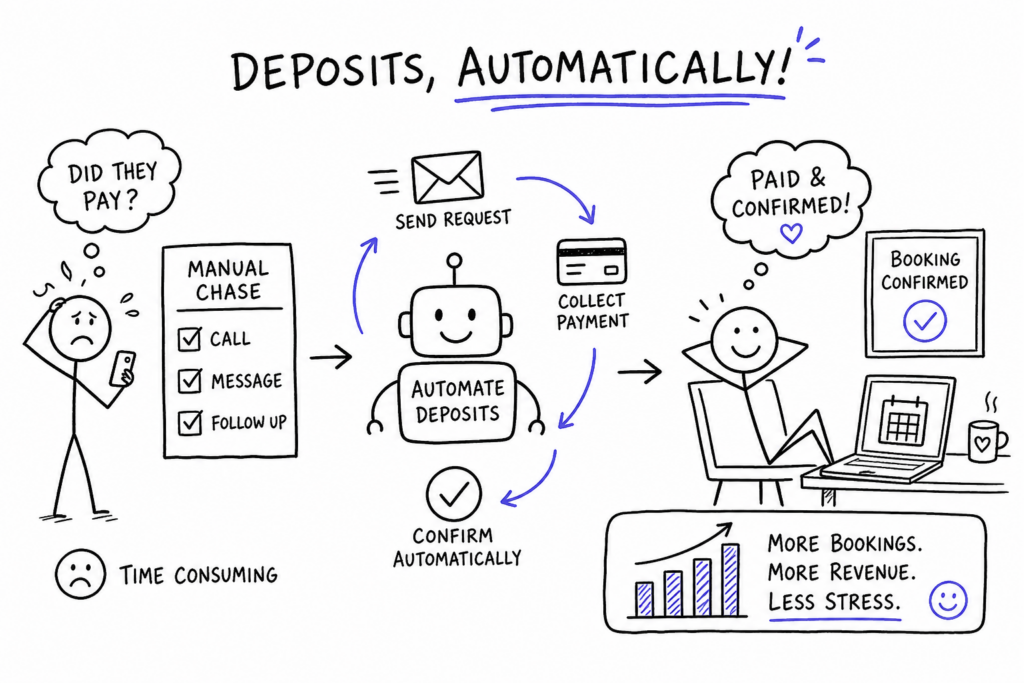
You know the story too well. A client confirms, you lock the calendar, prep references, maybe even sketch. The day arrives and the chair stays empty. There is no reservation deposit and no commitment; just a hole in your day that no walk-in can truly fill. It is not only lost revenue, it is lost momentum for your artists and a missed spot that a serious client would have loved. To prevent gaps, collect booking deposits at the time of scheduling so the session is real from the start.
A deposit is not a shakedown. It is a commitment tool that filters signal from noise and turns a tentative plan into a real booking. When you build prepayment into your scheduling flow, you remove the awkward dance of chasing money after the fact. Automated deposits act as a no-show fixer so you spend your time making art, not sending reminders.
That is why we built Tattoogenda around deposits done right. In this guide, you will pick the best method for your studio, set it up in your booking platform, write a client-friendly deposit policy, choose amounts that make sense, and handle refunds or disputes like a pro.
Why collecting booking deposits beats chasing clients afterward
The real cost of ghost bookings and last-minute cancellations
An empty chair costs more than a gap in the calendar. It is time you cannot sell again, plus design time, setup, cleanup, and energy that went nowhere. If your blended rate is $120 to $180 per hour, a two-hour no-show easily wipes out $300 or more by the time you count prep.
When there is no deposit, there is little consequence and almost no friction. Clients can reserve a prime slot with a single click, then change plans without a second thought. Studios that embed deposits and pair them with reminders often cut no-shows significantly; results vary by market, enforcement, and how consistently the policy is applied.
That reclaimed time compounds. It keeps your roster tight, your artists focused, and your waitlist moving for clients who are genuinely ready.
Why the timing of the deposit matters
Collecting at the moment of booking lands differently than an invoice sent three days later. When a client enters their card as part of scheduling, the session becomes real to them and they mentally commit. Push payment to a separate message and it turns into a task they will get to when they remember.
Manual follow-ups create an open loop for both of you. You send nudges, they promise to pay, and the slot is still not secure. Collect the deposit at the exact moment of scheduling so confirmation only happens after payment. You will feel the tone shift from chasing to serving.
The main methods to collect booking deposits when someone books
Immediate charge vs. card pre-authorization
With an immediate charge, the client pays a fixed amount or percentage right away. Funds settle to you in the usual payout window and the deposit is applied to the final bill at the appointment. This is straightforward and strongly signals intent.
With a card pre-authorization, you place a hold without taking the money. The funds are reserved for a limited period, often a few days up to several weeks on credit cards and typically shorter on debit, depending on the issuer and your processor’s rules. You can capture later or release the hold if plans change. Card holds are common in hospitality for incidentals, though they can expire before an appointment that was booked far in advance.
There is no one-size-fits-all answer. If you run a non-refundable policy, have long lead times, or want simple accounting, an upfront partial payment usually fits best. If the final amount is highly variable, or you want to avoid immediately debiting a customer’s card, a pre-authorization can be useful. Holds can lapse and may tie up a client’s debit balance, while immediate charges keep the commitment intact. Match the method to your policy, timeline, and client experience goals.
Payment links, manual invoicing, and why they do not scale
Sending a PayPal link, bank transfer details, or a manual invoice after someone books sounds easy until you do it at scale. It adds a second step the client has to complete later and creates a to-do list for your desk manager that never stops growing. Each extra step lowers conversions and increases ghosting.
Messages get buried. Staff spend evenings chasing payments. The admin cost eats into your margins and morale. The better model is to collect inside the booking form so the appointment is confirmed only after the deposit clears. If you must use payment links, automate reminders and deadlines, but understand you are starting from a weaker position.
Some industries use third-party deposit escrow, where a platform holds funds until the service is delivered. That setup is common in travel and marketplaces but can add complexity and delay refunds. For short, appointment-based work like tattoos, escrow rarely helps and often introduces friction without clear benefit. See how hospitality platforms handle similar hotel deposit workflows for an example of the differences in practice: hotel deposit practices.
How to collect booking deposits automatically inside a booking workflow
What the client experience looks like when it is built in
A smooth flow looks like this. The client selects an artist, chooses a session type and time, shares reference notes, and sees the required prepayment on the same screen. They pay, agree to your policy, then receive an instant confirmation with their appointment details and receipt.
There is no “please transfer by tomorrow” message. There is no invoice to find later. The deposit applies to the final balance automatically and the system sends reminders on your schedule. The studio sees a committed booking. The client sees a professional process.
On the back end, your calendar blocks the slot, your CRM records the deposit in the client history, and your consent form is linked to the appointment. If the client reschedules within your window, many platforms offer the option to carry the deposit forward once; verify the exact behavior in your booking provider’s settings.
Platforms that integrate deposits directly into scheduling
Platforms like Tattoogenda are built for tattoo and piercing studios and include deposit collection in the 24/7 booking link. In most systems, you can set a fixed amount or a percentage per service or artist, choose a rescheduling window, and turn on automated confirmations and SMS reminders. You can also require payment to confirm, availability and behavior depend on your booking provider and payment processor. Most platforms keep payment records organized for reconciliation at checkout.
Your policy can display during booking, be echoed in the confirmation email, and live in your digital consent form. If a client no-shows, the system applies the rules you set, no debate over what was agreed. Refunds or credits, when allowed by policy, can typically be processed from inside the booking platform; specifics vary by vendor and payment partner.
Not on Tattoogenda yet? Most booking tools include deposit or prepayment features. Use this universal setup checklist and look for the booking platform deposit settings labeled “deposit,” “prepayment,” “card hold,” or “require payment to confirm.”
- Choose a method: immediate charge for most sessions, or a card pre-authorization if you truly need a temporary hold.
- Set amounts: flat $50 to $100 for small pieces and piercings; $100 to $300 or 20% to 30% for large custom work.
- Define policy: rescheduling window, when deposits are forfeited, and how they apply to the final bill.
- Connect payments: link your processor, test a real booking, and verify receipts and refunds end to end.
- Require payment to confirm: enable the toggle so unpaid bookings never hit your calendar.
- Automate reminders: SMS and email on a tested cadence (for example, 48 and 24 hours; 72/24 can also work) with a link to reschedule inside your window.
- Train your team: one script, one policy, no exceptions at the front desk that the system cannot enforce.
Setting the right deposit amount for your studio
Percentage vs. fixed amount: what works for different session types
Fixed deposits keep things simple for straightforward work. Many studios run $50 to $100 for small to medium tattoos, and $20 to $50 for piercings or quick services. Large custom projects benefit from a percentage that scales with the time blocked, typically 20% to 30% of the estimate, or a flat $100 to $300 floor.
A tiered approach covers most scenarios. For example: piercings $25; flash or small $75; half-day $150; full-day 25%. The number should be meaningful enough to deter no-shows without scaring off serious clients. If you are unsure, start modestly, then adjust based on your actual no-show rate and client feedback.
Keep the math transparent. If you charge hourly, a deposit equal to one hour is a clear way to anchor the commitment and it reads as fair to clients.
Adjusting deposit requirements by artist and risk level
Match deposit strength to demand and risk. Senior artists with waitlists can justify higher prepayments and stricter windows. New artists filling portfolios might prefer a lower entry to keep their pipeline busy. First-time clients, peak hours, and guest-artist travel days deserve a firmer commitment than a weekday touch-up for a loyal regular.
Align the amount with your policy. The shorter your free reschedule window, the larger the portion a client forfeits if they cancel late. Many shops allow one reschedule without penalty, then hold or consume the deposit on a second change. Put this logic in writing and automate it in your booking system so staff do not have to referee edge cases.
Account for fees without nickel-and-diming. Card processing commonly runs about 2% to 3% plus a small fixed fee in many markets; actual rates vary by region, processor, and card type. Either absorb that cost or bake it into round numbers. Do not add surprise line items at checkout.
Writing a deposit policy that protects you without scaring clients off
What every studio deposit policy needs to cover
A strong policy answers the basics in plain language and in one screen. Cover these points clearly:
- Amount and timing: how much is due and that it is taken at booking as a partial payment.
- Application: deposit applies to the session total at checkout, not a separate fee.
- Rescheduling: how far in advance clients can move once without losing the deposit.
- Cancellation and no-shows: when the deposit is forfeited and what counts as a no-show or late arrival.
- Refunds: if any, the exact conditions and timeline in your refundable deposit policy.
Clients may hear different terms, reservation deposit, security deposit, even damage deposit in other industries, but in a studio context, be clear that this is a partial prepayment toward the session, not a separate fee. If a client has to read it three times, it is too complicated. Keep it short and consistent across your booking page, confirmation email, and digital consent form. Simplicity builds trust and protects you better than legalese.
How to word your policy so it builds trust, not friction
Lead with the why, then the rules. Here is friendly wording you can adapt to your studio tone:
- We reserve studio time just for you. A reservation deposit of $75 is collected at booking and applied to your final total.
- Need to move it? Reschedule once free with 48 hours’ notice. Less than 48 hours, or a no-show, and the deposit is held.
- Running late more than 15 minutes can shorten your session or be treated as a no-show.
- If we need to cancel, you choose a full refund or a credit. Credits remain valid for six months.
- By booking, you agree to these terms shown at checkout and in your confirmation email.
Position deposits as standard practice that protects everyone’s time. Mirror the policy in your consent form and your client’s ink passport or profile inside Tattoogenda so it is one story across touchpoints. Clarity reduces disputes before they start.
Handling refunds, cancellations, and the occasional dispute
Refundable vs. non-refundable: making the call for your studio
Many studios run non-refundable deposits with a fair rescheduling window. That protects your calendar while giving clients flexibility when life happens. Fully refundable policies are common in lodging but rarely make sense for appointment-based services where lost time cannot be resold at the last minute.
If you do allow refunds, define a hard cutoff, for example, refundable seven days out; credit only 48 to 168 hours out; forfeited inside 48 hours. Automate the refund through your booking system so it is processed quickly to the original method. Whatever you choose, apply it consistently and put the timing in writing.
Local consumer laws vary, so keep policies reasonable and transparent. Fairness plus good documentation is your best defense and your best client experience.
What to do when a client disputes a charge
Start with evidence. You need the booking confirmation, the policy the client accepted at checkout, the timestamped payment receipt, and any relevant message history about cancellations or lateness. That package solves most issues before they escalate.
Respond through your payment processor within the deadline, attach your documents, and reference the exact rule the client agreed to. Keep your tone calm and offer a one-time store credit if you decide the relationship is worth saving. Clear policies plus prompt, documented replies resolve the vast majority of disputes.
Booking platforms that centralize bookings, policy acceptance, deposits, reminders, and notes make pulling proof fast. Tattoogenda is designed to keep these records together so your team can focus on repairing trust or moving on, instead of reconstructing what happened across multiple apps.
Schlussfolgerung
The shift is simple. Move from manual deposits and follow-up messages to an automated flow where the prepayment is part of booking itself. No more chasing, fewer no-shows, and a professional client journey from the first click.
If you are ready to collect booking deposits automatically, without duct-taping tools, Tattoogenda has it built in from day one. Set your amounts, publish your policy, and let the system handle the rest while you and your artists get back to the work that matters.

 English
  Dutch
Dutch  Dutch (Belgium)
  French
  German
  Spanish