
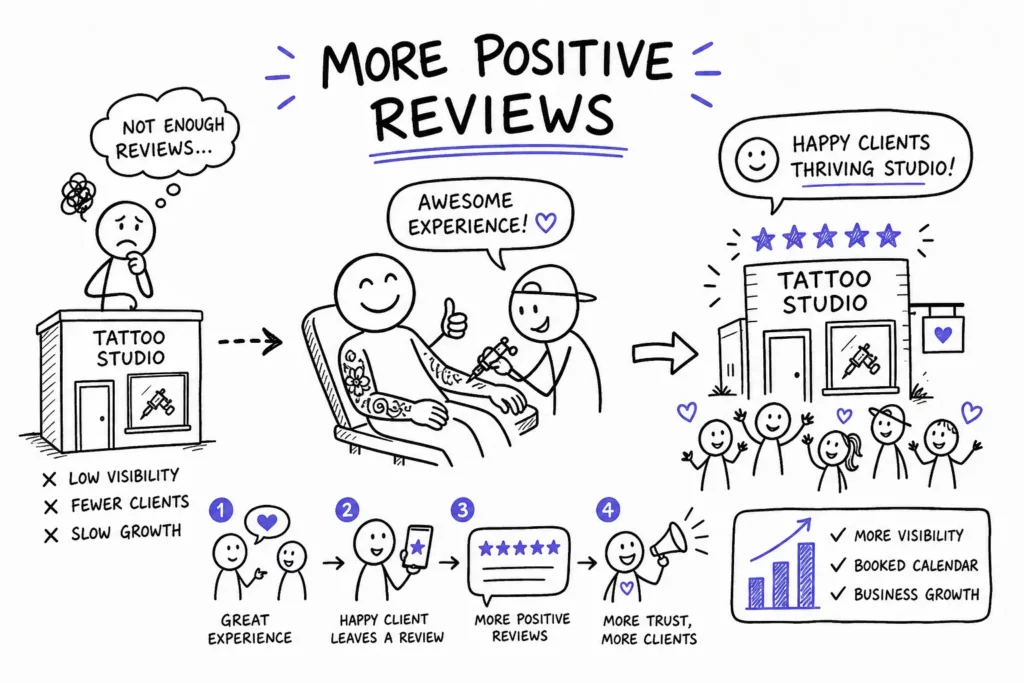
If you’ve been wondering how to get more positive reviews for your tattoo studio, the answer isn’t magic, it’s a system. Most studios are booked out weeks in advance, doing genuinely great work, and still sitting at a handful of Google reviews with a middling average. Often the larger issue isn’t the quality of the ink; it’s the absence of a repeatable review process. Without being asked, only about 5% of satisfied clients leave a review on their own. Ask them directly, and that number jumps to roughly 71%, a figure consistent with consumer survey research on prompted vs. unprompted review behavior. That gap is the entire difference between a studio that looks established online and one that looks like it opened last month.
The studios with the most reviews aren’t doing anything magical. They’ve built a reliable process: the right platforms, the right timing, the right words, and the right tools to make sure every happy client gets asked every single time. This article walks you through that entire system, from where to collect reviews, to what to say and when, to how to automate the follow-up, to what to do when a negative review lands.
How to Get More Positive Reviews for Your Tattoo Studio: Platforms to Prioritize
Not every review platform carries equal weight. Where you invest your energy first should be determined by where booking decisions actually happen, and for tattoo studios in the United States, that answer is clear.
Why Google Business Profile is your #1 priority
Google Business Profile controls your visibility in local search and Google Maps, which is where most clients are searching when they have real intent to book. Review volume, average star rating, and response activity all feed into Google’s local ranking algorithm. According to local SEO research, review signals consistently rank among the top factors in Local Pack placement. Analysis of top-ranked tattoo studios in competitive markets shows that studios in the top three local positions average 47 reviews, compared to 38 for positions seven through ten. More reviews, fresher reviews, and consistent review activity keep your studio visible to clients who are actively looking to book this week.
There’s also a trust threshold to keep in mind. Many clients filter for 4 stars and above, drop below 3 and a significant portion will skip your listing entirely. Maintaining a strong, active Google profile isn’t optional. It’s the foundation of your studio’s online reputation. Research on the impact of average star rating helps explain why that 4-star cutoff matters in local search and conversion.
Yelp and Facebook as supporting reputation layers
Once your Google profile is solid, Yelp and Facebook serve as useful secondary layers. Yelp still drives meaningful research traffic in major metros, and clients in cities like New York, Los Angeles, or Chicago often cross-reference studios across platforms before making a decision. Facebook functions more as a credibility checkpoint, the place someone visits to confirm the business is real and active before clicking “book.” Neither platform should pull focus away from Google early on, but both reward a consistent, complete presence. Building client testimonials across your tattoo shop profiles strengthens trust at every stage of the decision.
The in-studio experience that makes clients want to leave feedback
No review strategy works without the raw material. The moment a client decides whether they’ll leave a review isn’t at checkout, it forms during the session itself. Clients are paying attention to how they’re treated from the second they walk in, and the emotional quality of that experience determines whether they feel moved to share it publicly.
Small moments that turn a session into a 5-star story
The micro-interactions compound. Greeting the client by name when they arrive. Showing the stencil placement carefully and giving them time to confirm before committing. Explaining what the healing process will look like before they leave. Making the checkout feel smooth and unhurried, none of these are grand gestures, but they’re exactly what clients describe in their best reviews. Analysis of common tattoo studio complaints is consistent: most negative reviews focus not on the art itself but on how the client was treated, whether they felt rushed, whether pricing was explained upfront, and whether the space looked and felt clean. The studios that earn consistent 5-star reviews are the ones that have standardized these touchpoints into their daily operations.
Why the checkout moment is more powerful than studios realize
The emotional high of seeing finished ink is one of the best moments in the entire client journey to ask for a review. The client is satisfied, the session is fresh, and goodwill is at its peak. A brief, warm, direct ask at this moment, before the client steps out the door, converts at a significantly higher rate than a follow-up message sent days later. Use this window intentionally. Once the client leaves, it starts closing fast.
When to ask and exactly what to say
Timing and wording together determine whether a client actually follows through. The goal is to capitalize on peak satisfaction immediately after the session, then space follow-ups far enough apart to feel helpful rather than pushy.
Review request scripts for tattoo artists that actually convert
The structure that works across every channel is the same: gratitude, a clear ask, a reason it matters, and an indication that it won’t take long. Here’s how that plays out in practice. For additional templates and language ideas, see these review request scripts that studios adapt for SMS and email.
In-person at checkout: “Hey, really glad you’re happy with it. Would you mind leaving us a quick Google review? It only takes about 30 seconds and honestly helps us a lot when people are looking for a studio.” Keep it warm, specific, and short. Never make the client feel obligated, make them feel like they’re doing something genuinely useful.
SMS within 30-60 minutes: “Hi [Name], thank you so much for coming in today. If you’re happy with your new tattoo, we’d love a quick Google review. Here’s the direct link: [link]. Takes less than a minute!”
Email same day or next morning: “Hi [Name], it was great having you in the studio today. If you loved your experience, we’d be really grateful if you could take 2-3 minutes to leave us a review on Google. Here’s the link: [link]. It helps other clients find us and means a lot to the whole team.”
These scripts work because they give the client a reason, it helps the studio grow, it helps other clients find the shop, and make clear that the effort is minimal. Vague asks get ignored. Specific, easy asks get completed.
The follow-up sequence and what to do when clients don’t respond
If a client doesn’t respond to the first SMS or email, send one reminder at the 3-4 day mark, then a final gentle nudge at 7-10 days. Both follow-ups should go only to non-responders and should feel human, not automated. At the studio itself, a QR code card left at the counter or included with aftercare instructions gives clients a low-pressure path to leave feedback whenever they’re ready. A five-touch cadence, in-person ask, SMS, email, 3-day reminder, and a final 7-10 day nudge, covers the full window of peak satisfaction without crossing into annoying territory. For help building a follow-up cadence that converts, there are industry guides and tools that show common timing patterns and messaging sequences.
How to automate the review ask so no happy client slips through
Manual follow-ups are easy to skip on a busy studio day. An artist finishes a six-hour back piece, cleans up, moves on to the next client, and the follow-up message never gets sent. That’s the point where most studios’ review systems quietly fall apart.
What Tattoogenda’s post-appointment workflow looks like in practice
Tattoogenda’s integrated CRM and automated messaging tools send post-appointment review requests by SMS and email on a set schedule, triggered the moment an appointment is marked complete. The studio owner sets the message once, configures the timing, and the system handles the rest. An automated thank-you goes out within the hour with a direct review link, and a follow-up queues automatically for non-responders at the 3-4 day mark. No manual texting, no dropped balls, no relying on a busy artist to remember one more thing at the end of a long day. Learn more about How tattoo studios use client feedback management to grow, tattoogenda.com.
Why consistency beats effort when collecting tattoo shop reviews
The studios with the most reviews aren’t asking more creatively, they’re asking more consistently. Automation removes the human variable entirely. When a studio runs multiple artists across a full week of appointments, the numbers add up fast. Ten artists, five appointments each per week: that’s 50 review requests going out every week without anyone on your team lifting a finger to send them. One extra review per client per month, at that volume, compounds into a meaningful competitive advantage over the course of a year. If your studio includes rotating or visiting talent, check this guide on How to manage guest tattoo artists in your studio to keep scheduling and messaging consistent across the team.
Platform rules every studio owner needs to know before asking
Asking for reviews the wrong way can get your profile flagged, penalized, or worse. Each major platform has its own rules, and the differences matter.
What you can and can’t do on Google, Yelp, and Facebook
Google allows you to ask clients for reviews freely, but explicitly prohibits offering any incentive, no discounts, no gifts, no free touch-ups in exchange for feedback. Yelp takes a stricter position: the platform prohibits businesses from soliciting reviews at all and can issue a Consumer Alert on your profile if it detects suspicious or compensated review activity. The practical approach with Yelp is to ensure your profile is complete and well-maintained, then let organic reviews come in without actively directing clients there. Facebook prohibits incentivized reviews but does not ban a straightforward, neutral ask the way Yelp does, so a simple request is acceptable as long as no reward is attached. Check each platform’s current policy pages directly; for a concise summary of platform rules see this overview of online review rules for Google, Facebook, and Yelp.
The one rule that protects all your review profiles
Send review requests to all clients equally. The practice of filtering satisfied clients toward Google and directing unhappy ones elsewhere, sometimes called “review gating”, violates platform policies and can trigger penalties across your profiles. Keep the process neutral and consistent. Every client who completes an appointment gets the same request, regardless of whether you think they had a perfect experience. This protects your profiles and keeps your review stream authentic.
Responding to negative reviews without making things worse
Every studio gets a bad review eventually. How you respond publicly signals far more about your professionalism than the complaint itself. Prospective clients read negative reviews specifically to see how the studio reacts, and a calm, empathetic response often impresses them more than the complaint damages your reputation.
A response formula that works every time
Three parts: thank the reviewer, acknowledge the specific concern with empathy, and offer a path to resolve it offline. Keep the response to 2-3 sentences, stay professional, and never argue about artistic judgment in a public thread. Here’s a template you can adapt: “Thank you for sharing this, [Name]. We’re sorry your experience with [service] didn’t meet expectations, and we’d like to make it right. Please reach out to us at [contact] so we can discuss next steps privately.” No defensiveness, no explaining your artistic process, no blaming the client.
Using critical feedback to strengthen your tattoo studio’s reputation
A thoughtful response to a negative review often reassures undecided readers more than the original complaint worries them. Over the longer term, the most effective damage control is a consistent flow of new positive reviews: they dilute the weight of any single negative one and signal that your studio is active, responsive, and continuously earning client trust. For tactical advice on protecting and improving your studio’s online presence, see this guide on how to manage your tattoo shop’s online reputation. This is another reason the automated ask system matters, it keeps new reviews coming in steadily, so your profile always reflects your current quality rather than one bad day from six months ago.
Build the system and let it run
Knowing how to get more positive reviews for your tattoo studio comes down to execution, not inspiration. Prioritize Google, earn the review through a consistently excellent client experience, ask at the right moment with clear and natural language, and automate the follow-up so nothing slips through. Stay compliant with platform rules, and respond to criticism with professionalism and calm.
It’s not about having a perfect day every day. It’s about building a process that works in the background while your artists focus on the work. The studios winning in local search right now aren’t doing anything more creative than you, they’re just asking every client, every time, without fail. That’s how you increase 5-star reviews at your tattoo parlor and build the kind of online reputation that fills your books.
If your artists are booked solid but your Google review count doesn’t show it, Tattoogenda is built to close that gap. From automated post-appointment review requests to a full CRM that keeps your client relationships organized, it’s studio management software designed specifically for tattoo and piercing studios. Stop leaving reviews to chance, learn more about More tattoo client reviews with feedback management software and see what a purpose-built platform can do for your reputation.

 English
  Dutch
Dutch  Dutch (Belgium)
  French
  German
  Spanish