
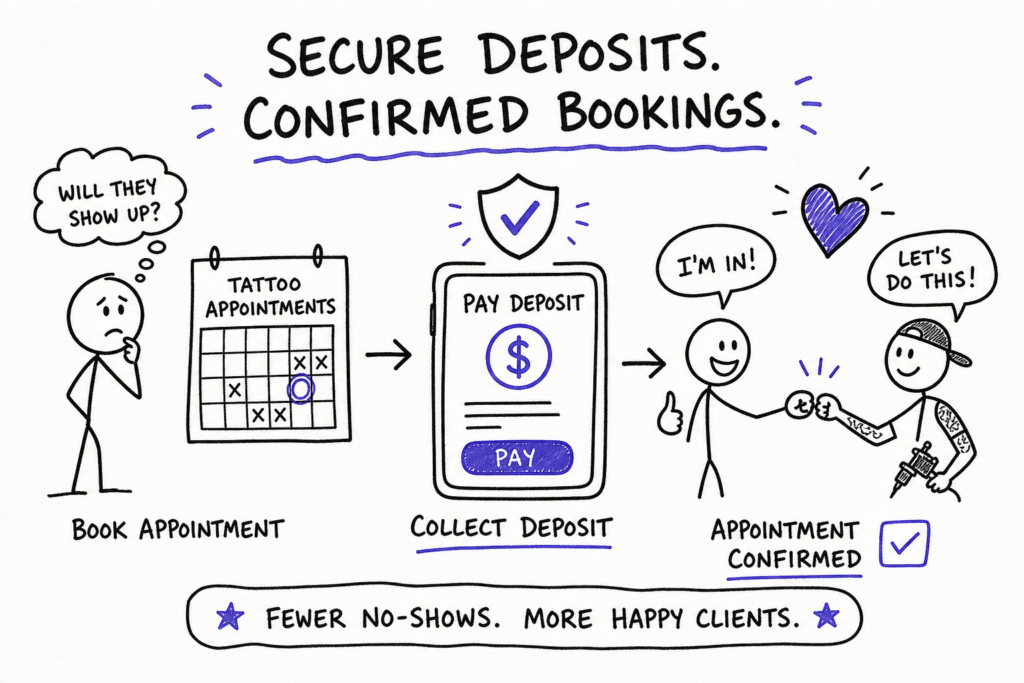
Picture this: it’s Saturday morning, your books are full, you’ve spent four hours designing a custom sleeve, and two clients simply don’t show up. No text, no call, nothing. That’s roughly $600 in lost revenue and an entire morning of prep work gone, based on a standard three-hour session at $200 per hour, and you have no recourse because you collected nothing upfront. It’s a hypothetical, but it plays out in studios every week.
Many artists already know they should collect deposits. The problem is how they do it. Chasing PayPal payments through DMs, sending Venmo requests manually, and hoping clients follow through creates friction, inconsistency, and awkward follow-up conversations. It also leaves no clean paper trail when a dispute shows up later. The good news is that modern studio management software can substantially reduce this friction by folding deposit collection directly into the booking flow, and that’s exactly what this guide covers.
This article walks you through how to collect deposits for tattoo appointments online: how much to charge, which platform handles this best, how to configure your deposit settings step by step, and what to do when a client files a dispute. By the end, you’ll have a system you can turn on before next week’s appointments.
Why collecting an upfront deposit protects your livelihood
The real math behind a missed appointment
A three-hour custom sleeve session at $200 per hour is $600 in lost income. Add the consultation time, the reference gathering, the design sketch, and the mental preparation, and you’re looking at another two to three hours of unpaid work. A $100 or $150 deposit doesn’t make you whole, but it compensates for the prep time and, more importantly, it screens out the clients who were never fully committed in the first place.
Studios that don’t collect deposits tend to sit nearer the higher end of the industry’s no-show range, which runs roughly 8% to 20% of all appointments. That’s a meaningful chunk of revenue walking out the door each month. Collecting a booking deposit for tattoo appointments is one of the most direct ways to move that number down.
How financial commitment changes client behavior
Industry data on service-based appointment businesses points in a consistent direction: deposits reduce no-shows, and deposits combined with automated reminders deliver the strongest reduction of all. SMS reminders alone have been associated with no-show rate cuts of 38% to 40% across appointment-based services. Pair those reminders with a financial stake, and the effect compounds. A client who has $100 locked in is more likely to show up, reschedule in advance, or at least communicate. A client who booked for free has nothing at stake and nothing to lose by ghosting you.
Deposits also change the quality of your bookings. Someone who hesitates to pay a reasonable deposit is often the same person who would have been a difficult client anyway, the kind who reschedules twice, changes the design at the last minute, and haggles at checkout. The filter works in your favor before the appointment ever happens.
Setting the right deposit amount and writing a policy that holds up
Flat fee vs. percentage: which model fits your booking style
Flat fees work well for standard appointments. Most studios charge between $50 and $200 depending on session length, with $100 being a commonly used baseline. For quick flash pieces and single-session bookings, a $50 deposit is usually enough to create commitment without deterring new clients. For longer standard sessions, $100 to $200 is appropriate and defensible.
Percentage deposits make more sense for large custom work where design time is substantial. The industry standard sits at 25% to 30% of the estimated total. Some high-volume studios charge the equivalent of the first hour of work as the deposit for any session over two hours. That approach is easy to explain and proportionate to the prep time at risk. For large multi-session pieces, deposits of $150 to $500 are common and expected by clients who understand the scope of the work.
Sample deposit policy wording to use right now
Your policy needs four non-negotiable elements: the deposit amount, clear non-refundable language, the cancellation notice window, and a statement on whether the deposit transfers to a rescheduled date. It must be visible before payment and accepted by the client via a checkbox or digital acknowledgment. Hiding it in fine print weakens enforceability in most jurisdictions.
For a standard appointment, this wording works well:
“A deposit of $100 is required to secure your appointment. This deposit is applied to the total cost of your tattoo and is non-refundable. Cancellations or reschedules with less than 48 hours’ notice may result in forfeiture of the deposit.”
For larger custom work, use a slightly more detailed version:
“For custom tattoos, a deposit of 30% of the estimated total is required to reserve your session. This deposit is applied to your final balance and is non-refundable. If you need to reschedule, please provide at least 72 hours’ notice. Cancellations, no-shows, or late reschedules may result in the deposit being retained as compensation for design and booking time.”
One consistency note: if you sometimes refund deposits informally, clients can and will argue that your policy isn’t firm. Apply it uniformly or it loses its teeth.
How to collect deposits for tattoo appointments online: choosing the right platform
What separates tattoo-native tools from generic payment processors
Square and Stripe can technically collect a payment. But they aren’t built around tattoo booking logic: artist-specific availability, session length variations, multi-step custom quote workflows, or consent forms tied to the client record. Generic platforms typically require you to stitch those pieces together yourself, which means more manual work and more gaps where things go wrong. How well a payment gateway for tattoo artists fits your workflow depends on whether it was designed with studio operations in mind or adapted from a general-purpose tool.
A deposit platform built for tattoo studios needs to handle several things without extra configuration:
- Collect the deposit at the point of booking, not as a separate invoice step
- Automatically apply the deposit toward the final balance at checkout
- Display the refund policy clearly before the client pays
- Trigger automated reminders after deposit payment is confirmed
- Log the policy acceptance with a timestamp for dispute protection
Why purpose-built studio software handles deposits better
This is where Tattoogenda stands out for working studios. Built by active tattoo studio owners, Tattoogenda folds the entire deposit workflow into the booking flow: the client selects their artist, chooses a session type, sees the deposit requirement, pays securely, and receives an automatic confirmation that restates the policy. No separate invoices, no DM follow-ups, no manual reconciliation at the end of the day. You can also Build a tattoo studio deposit workflow that runs itself to automate these steps across your team.
Beyond deposit collection, Tattoogenda connects every paid deposit to automated SMS and email reminders. That combination, financial commitment plus timely reminders, is the most effective no-show prevention setup available to a working studio. Everything runs automatically once you configure it, which means you spend your time tattooing rather than chasing bookings. Learn more about The tattoo deposit system that ends studio no-shows.
Setting up online deposits in your booking flow, step by step
Configuring your deposit settings in your booking software
In Tattoogenda, the setup takes a few minutes. Navigate to your booking settings, define the deposit type as flat or percentage, assign it to specific service types or individual artists, set the cancellation window, and enter the policy text clients will see at checkout. Every client who books through your link will encounter the deposit requirement and policy acknowledgment before payment is processed.
If you’re currently using Square Appointments, the navigation path is: Dashboard > Appointments > Settings > Payments and Cancellations > Deposit. From there, choose between a fixed amount or a percentage, write a custom policy statement, and save. The deposit is deducted from the total automatically at final checkout. Note that Square requires identity verification before this option becomes available, see Square’s community guide on setting up deposits before booking for details.
What clients see during the booking process
A smooth client-facing experience at booking is what prevents friction and disputes later. When the deposit prompt appears as a natural step in the checkout process rather than a separate payment request, clients accept it without pushback. The confirmation email that follows restates the terms clearly, which means the client has received written notice twice before they ever walk through your door.
The remaining balance is tracked automatically on platforms that support deposit application, so both you and the client know exactly what’s owed at the end of the session. There’s no confusion, no awkward recalculation at checkout, and no opportunity for misunderstanding about what the deposit covered.
Pairing deposits with automated reminders for maximum effect
Accepting deposits at booking reduces no-shows on its own. Combine them with automated reminders and the effect goes further. Multi-channel reminders, SMS plus email, are associated with no-show rate reductions of 50% to 65% compared to bookings with no deposit and no reminder system. In practical terms, a studio averaging 15% no-shows could cut that figure to 6% to 8% with this setup. That’s meaningful revenue recovery without adding a single new client. For additional tactics, see avoiding no-shows: best practices for tattoo artists.
Tattoogenda’s reminder system fires automatically after deposit payment is confirmed. Clients receive a reminder at the interval you configure, which keeps the appointment front of mind and gives them an easy path to reschedule if something genuinely comes up. The result is fewer no-shows and fewer last-minute surprises on both sides. For an overview of how appointment reminders work across channels, this appointment reminder systems resource is a helpful reference.
Protecting yourself from chargebacks and client disputes
What card networks look for when a client files a dispute
A non-refundable deposit policy does not prevent a client from filing a chargeback. Visa and Mastercard both allow cardholders to dispute a charge under reason codes covering services not received, services not as described, or credit not processed. The dispute outcome hinges on documentation, not policy wording alone. What card networks want to see is: written acknowledgment of the non-refundable terms, a timestamped booking confirmation, communication logs, and evidence of preparatory work such as design sketches or consultation notes. Having a recognizable business name on the card statement also helps, an unrecognizable descriptor is one of the most common triggers for friendly fraud disputes. For deeper background on how Visa chargebacks are managed, consult this Visa chargebacks guide.
The documentation habits that win deposit disputes
Your booking software is your evidence trail. A platform that captures a timestamped policy acceptance, sends a confirmation email restating terms, and logs all client communication gives you exactly what you need if a dispute lands on your desk. Contrast that with informal deposit collection via PayPal or bank transfer, where policy acknowledgment is often absent entirely and proving the client agreed to your terms becomes nearly impossible.
Consistency matters here as well. If you’ve informally refunded deposits in the past, a disputing client can argue that your policy isn’t actually enforced. Apply your policy the same way every time, document every communication, and your position in any dispute will be significantly stronger. The studios that lose chargebacks almost always lose them because of missing documentation, not because their policy was wrong.
A studio that runs without the chasing
A studio with online deposits running inside the booking flow operates more professionally, loses less income to no-shows, and frees up the time artists were spending on manual payment follow-up. You now have the key decisions mapped out: the right deposit amount for your session types, policy language you can actually enforce, and a clear understanding of what makes that policy defensible in a dispute.
The platform you choose makes the biggest practical difference. Generic payment tools can technically collect money, but they weren’t designed around how a tattoo studio books, prices, and communicates. Tattoogenda was built specifically for this: the full workflow from online booking to deposit collection to automated reminders runs in one place, without extra configuration or manual steps between each stage. If you’d like to compare other booking solutions, check out Venue.ink as an example of an alternative approach.
If you want to know how to collect deposits for tattoo appointments online and have it working before your next round of bookings, Tattoo deposit collection: policies, tools & templates and Tattoogenda’s booking and deposit features are the place to start. The configuration takes one focused session, and the impact on your no-show rate tends to show up within the first few weeks.

 English
  Dutch
Dutch  Dutch (Belgium)
  French
  German
  Spanish