
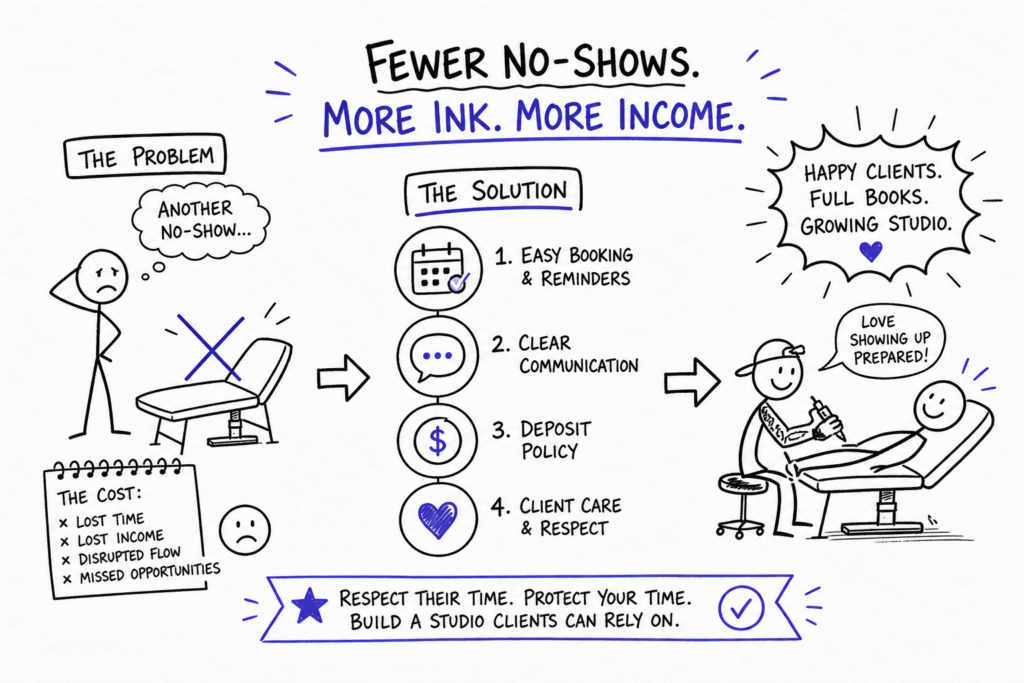
A 4-hour session block. A prepared artist. A studio opened on time. Then nothing. The client doesn’t show, doesn’t call, and the slot is gone for the day. No income, no walk-in to fill the gap, just overhead ticking in the background. To reduce client no-shows, studios need systems in place before problems like this become routine, because across appointment-based businesses, they happen far more often than most owners track.
Across service industries, the average no-show rate sits around 23%, based on cross-industry meta-analyses of appointment data. Tattoo studios don’t have a published benchmark, but studio owners commonly report rates between 15% and 25% without any prevention systems in place, an anecdotal range drawn from practitioner conversations rather than a formal survey. When you combine long session lengths with the prep time artists invest in custom designs, a single missed appointment can erase the margin for an entire day. Consider the math: a 4-hour session at $100 per hour, lost entirely, wipes out $400 in revenue while studio overhead keeps running.
The good news: this is a solvable problem. Studios that automate the right workflows, starting with deposits and reminder sequences, routinely cut their missed appointment rate by 30% to 50%. This article walks through the exact tactics, message templates you can use today, and a simple way to measure whether they’re working.
Why tattoo studios lose more money to no-shows than most businesses
Consider a concrete example. A 4-hour session priced at $400 that no-shows generates zero revenue. The artist’s time is gone. The studio overhead still ran. The slot that could have gone to a waitlisted client sat empty instead, and unlike a 30-minute salon appointment, where the loss is frustrating but contained, a missed tattoo session can wipe out the profitability of the entire day. The session length is what makes the math so unforgiving.
Estimates from tattoo-specific data suggest studios lose between $1,200 and $15,600 annually from no-shows, with busier multi-artist shops sitting at the higher end. At $150 to $200 per missed hour, even two no-shows a week compounds fast across a year. The longer your average session, the more each empty chair costs relative to other appointment-based businesses.
The target benchmark worth aiming for is below 10%. Anything above 15% consistently signals a structural issue, not a string of bad clients. Research on prevention systems, deposits, automated SMS reminders, and confirmation workflows, shows they are among the primary drivers separating studios with a 20% no-show rate from those running closer to 7%, though client mix and booking channel also play a role.
How to Reduce Client No-Shows with Deposits
A deposit converts a casual booking into a real commitment. Clients who pay upfront cancel at dramatically lower rates because the appointment is no longer free to abandon. There’s a real psychological shift that happens the moment money changes hands: the session moves from “something on the calendar” to “something I’ve already invested in.” While rigorous tattoo-specific studies are limited, this effect is well-documented in analogous service industries where prepayment consistently reduces abandonment.
Most studios charge either a flat fee or a percentage of the estimated session cost. Flat deposits between $50 and $100 work well for shorter sessions. For multi-hour custom work, a percentage-based deposit is more common, though reported studio practices vary, check what’s standard in your market before setting a rate. The framing matters as much as the amount. Telling a client “your deposit holds your time exclusively with your artist” lands very differently than “we charge a fee to book.” One communicates value; the other sounds like a penalty.
The non-refundable versus transferable question splits studio owners, and the answer is nuanced. Strictly non-refundable deposits do prevent no-shows, but they can trigger chargebacks and damage a relationship when a client has a genuine emergency. Transferable deposits, applied to a rescheduled session when the client gives enough notice, strike the better balance. They still create the financial commitment that deters ghosting, while leaving room for goodwill. Set the reschedule window clearly: 24 to 48 hours minimum is the window most commonly enforced, giving you enough lead time to fill the slot.
Reminder Sequences That Reduce Client No-Shows
A study analyzing 53 million appointments found that SMS reminders alone reduce no-shows by an average of 38% to 42%. That’s not a marginal improvement. Paired with deposits and a clear cancellation policy, a well-timed reminder sequence is one of the most reliable ways to reduce client no-shows at scale. The timing of those reminders matters as much as sending them at all. For a closer look at the large-scale research behind reminder effectiveness, see this analysis of 53 million appointments.
The sequence that performs best for tattoo studios runs like this: a confirmation message immediately after booking, a reminder seven days out, another 24 hours before the session, and a final nudge one to two hours beforehand. Each touchpoint addresses a different failure point. The week-out reminder catches scheduling conflicts early. The 24-hour message gives clients a chance to reschedule rather than go silent. The same-day nudge catches the clients who simply forgot.
On the channel question, the data is clear. SMS open rates run at 90% to 98% within 30 minutes of delivery. Email gets read eventually, but the urgency is gone by then. For time-sensitive reminders, SMS is the primary channel. Email works well for the booking confirmation, where clients want something they can search and reference later. For tactical guidance on crafting SMS reminders and timing, review this SMS appointment reminder best practices and this appointment reminders guide.
Here are three templates you can put to work immediately:
- Booking confirmation (immediate): “Hey [Name], you’re booked with [Artist] on [Date] at [Time]. Reply YES to confirm or call us to reschedule. See you soon.”
- 24-hour reminder: “Hi [Name], your session is tomorrow at [Time]. Reply YES to confirm or let us know ASAP if you need to reschedule.”
- 2-hour nudge: “Quick reminder: your appointment is in 2 hours at [Time]. We’re ready for you. See you soon.”
These are short, direct, and ask for a confirmation action. That two-way element matters: when clients reply to confirm, they’ve made a micro-commitment that makes them less likely to bail. Two-way SMS engagement has been shown to increase appointment confirmations compared to one-way broadcast messages, the reply itself reinforces the client’s intention to show up. For a step-by-step on how tattoo shops can set up automated text reminders for tattoo shops, follow that practical guide.
A cancellation policy that actually protects your studio
A clear cancellation policy removes the ambiguity that leads to disputes and awkward conversations. Without one, every situation becomes a judgment call made under pressure. With one, the rules are set before the relationship starts, and both sides know what to expect.
Your policy needs to state three things plainly: the notice window required to reschedule without losing the deposit (commonly 24 to 48 hours, which gives you realistic time to rebook the slot), what happens to the deposit if that window is missed, and whether rescheduling is permitted and how many times. Write it in plain language, not legal boilerplate. Clients read and respect clarity. They disengage from dense fine print.
Place the policy in three spots: the booking confirmation message, a digital form the client signs or agrees to before their appointment, and a line in the 24-hour reminder. When clients see the policy before they book and again before they might bail, it handles most situations proactively. Trying to enforce a policy after someone ghosts you is a harder conversation, and a far less productive one. If you have questions about the legality and enforcement of no-show fees and refund policy language, this industry memo on no-show fee legality is a useful starting point.
Closing the gaps deposits and reminders don’t cover
A waitlist fills the slots that prevention doesn’t fully close. Keep a short list of clients who’ve opted in at booking to take a cancellation slot on short notice. Make the opt-in frictionless by asking about it during the booking process rather than as a separate step later. Even filling a handful of last-minute gaps each month can noticeably improve your revenue picture, a modest recovery rate on cancellations adds up faster than most studios expect.
Easy rescheduling is underused as a prevention tool. Many no-shows happen because the client felt awkward about canceling and chose avoidance over a difficult conversation, a pattern observed broadly across service businesses where rescheduling friction is high. Give them a low-friction path out: a link in the reminder text, a simple phone number, or a two-way reply option. When rescheduling feels easy, clients choose it over going silent. That keeps the relationship intact and gives you a real shot at filling the slot.
Small relationship touchpoints between booking and session also help reduce client no-shows. A brief message a few days after booking, asking about design ideas or whether the client has prep questions, keeps the appointment emotionally real for them. The session stops being a calendar entry and becomes something the client has been thinking about and talking to you about. Service-industry research on pre-appointment engagement suggests that sustained light contact between booking and visit correlates with lower drop-off rates, even when the contact isn’t explicitly about the appointment itself.
Tracking your results and pulling it all together
Before you can measure improvement, you need a baseline. Divide your missed appointments by your total booked appointments over the last 90 days and multiply by 100. That percentage is your starting point. For example: 8 missed appointments out of 50 booked gives you a 16% no-show rate. Set a three-month target of reducing it by 30% to 40% using the tactics in this article, a range consistent with what combined SMS and deposit interventions produce in the research. Track monthly rather than weekly to avoid overreacting to normal variation.
The practical challenge with running deposits, reminders, cancellation policies, and waitlists as separate pieces is that each one adds admin time. Picture it: one tool for SMS reminders, a separate payment link for deposits, a paper form for consent, and a spreadsheet for the waitlist. That’s where studios hit a ceiling, the tactics work, but the manual overhead of managing them across multiple tools doesn’t scale. Tattoogenda was built specifically for tattoo and piercing studios to consolidate all of this into one workflow: automated SMS and email sequences, secure deposit collection at booking, digital consent forms, and client history that makes rescheduling straightforward, running from one platform rather than five disconnected tools.
For studio owners who want to reduce client no-shows without hiring a coordinator to manage the process, that kind of consolidation removes the ceiling. You can explore how it works at tattoogenda.com.
No-shows are not just an inconvenience. They’re a direct tax on your revenue and your artist’s time, one that compounds quietly across the year. A studio losing two sessions a week to no-shows at $200 per hour is looking at over $15,000 in lost annual revenue, and that’s before accounting for the overhead that ran anyway. For additional industry statistics on appointment no-shows across sectors, see this appointment no-show statistics overview.
The tactics covered here, starting with deposits and a timed reminder sequence, can cut missed appointments by 30% to 50% with consistent application. Pick three to implement this week, set your baseline, and track the results over 90 days. Reducing client no-shows isn’t about punishing your clients. It’s about running a professional studio that respects everyone’s time, including your own. For a deeper dive into the financial implications, read The Real Cost of No-Shows in Tattoo Studios.

 English
  Dutch
Dutch  Dutch (Belgium)
  French
  German
  Spanish