
Three hours blocked. A custom design drawn up. Materials prepped and ready. Then the client doesn’t show, doesn’t call, and doesn’t respond to messages. No deposit was taken, so there’s nothing to fall back on and no real consequence for them. That scenario plays out in tattoo studios every week, and it’s almost always the result of one missing piece: a defined deposit workflow for collecting, managing, and applying deposits from the moment a client books.
Deposits aren’t just about protecting revenue. They’re a commitment mechanism. When a client pays upfront to hold their appointment, they have skin in the game. The casual inquiry becomes a confirmed booking. The “I might reschedule” becomes an actual session. Studios that have built a clear deposit process tend to see fewer no-shows, less awkwardness at checkout, and a more professional experience for both the artist and the client.
Each stage of that process is covered below, from the moment a client clicks “book” to the moment they walk out after their session. At the end, you’ll see exactly how Tattoogenda handles the entire deposit workflow automatically, but the principles apply regardless of the tools you use.
Why studios without a deposit workflow keep losing revenue
The hidden cost of informal booking practices
Most studios struggling with no-shows don’t have a pricing problem or a difficult client base. They have a process problem. When someone can book a three-hour custom session with nothing more than a name and a phone number, canceling feels consequence-free. From the client’s perspective, nothing is at stake. From the studio’s perspective, that blocked slot represents lost walk-in revenue, wasted prep time, and a calendar that looked full but paid nothing.
The compounding cost adds up fast. Consider a studio running five artists, each experiencing just one no-show per week at an average session rate of $200. Run that math, five artists, one missed session each, 52 weeks, and you’re looking at over $50,000 in lost revenue annually. That’s before factoring in materials prepared, potential walk-in clients turned away, and the mental load of chasing people who don’t respond. The problem isn’t the clients. It’s the system that allowed the booking without any friction.
What “we’ll sort it on the day” actually costs you
Many independent artists and smaller studios rely on trust or verbal agreements to handle deposits informally. That works fine when the studio has a handful of regulars and nothing much to lose. It breaks down completely when you’re running multiple chairs, handling dozens of bookings a month, and expecting different front desk staff or artists to apply the same booking logic consistently.
The other moment this falls apart is at checkout. Without a clear record of what deposit was paid and how it applies to the final bill, you get the awkward conversation where a client tries to negotiate their deposit off the total, or worse, claims they never paid one. A defined deposit workflow eliminates that conversation entirely by establishing the rules before the client even books, not after they’re sitting in the chair.
What a complete tattoo studio deposit workflow actually looks like
The three stages every deposit must move through
A working deposit workflow has three distinct stages: collection at booking, management between booking and appointment day, and application at checkout. Each stage depends on the one before it. If collection is inconsistent, management becomes impossible. If management is messy, checkout turns into a guessing game.
Think of it as a loop rather than a straight line. The deposit collected when a client books needs to be visible, documented, and automatically linked to that specific appointment so that when checkout arrives, there’s no manual calculation, no memory required, and no room for dispute. Most studios that struggle with this miss exactly that connection, the deposit gets collected but never properly tied to what happens at the end of the session.
Where most studios leave gaps in the process
Two failure points show up repeatedly. The first is no confirmation to the client that their deposit was received. Without an automatic receipt, clients genuinely forget they paid, misplace the amount, or claim the payment was never processed. The second is no clear record at checkout of how the deposit should be applied, which creates confusion on multi-session projects or appointments that ran longer than estimated. Fix both of those gaps and you’ve closed the most common sources of deposit-related friction.
Deposit workflow step one: collecting the deposit when the client books
Setting the right deposit amount for your studio
Industry practice for tattoo studios typically falls between $50 and $200 as a flat fee, or 10 to 20 percent of the estimated session total. For large custom pieces requiring significant design time, a higher flat amount or percentage makes sense. For flash work or shorter sessions, a lower flat fee is usually enough to filter serious clients from casual inquiries without creating a barrier for people who genuinely want to book.
The goal is a number that signals commitment, not one that feels like a barrier to entry. A $50 deposit on a $600 sleeve consultation tells the client their time and yours are both worth something. A $200 deposit on a $250 flash piece will cost you bookings. Calibrate the deposit to the size and nature of the session, and document that logic so every artist in the studio applies it consistently.
Making the payment step frictionless
The fastest way to lose a deposit is to make the payment process complicated. If a client has to wait for a manual invoice, send a bank transfer, or track down the artist on social media to confirm their booking, a significant percentage simply won’t complete the step. The deposit needs to be part of the booking confirmation itself, not a separate follow-up action.
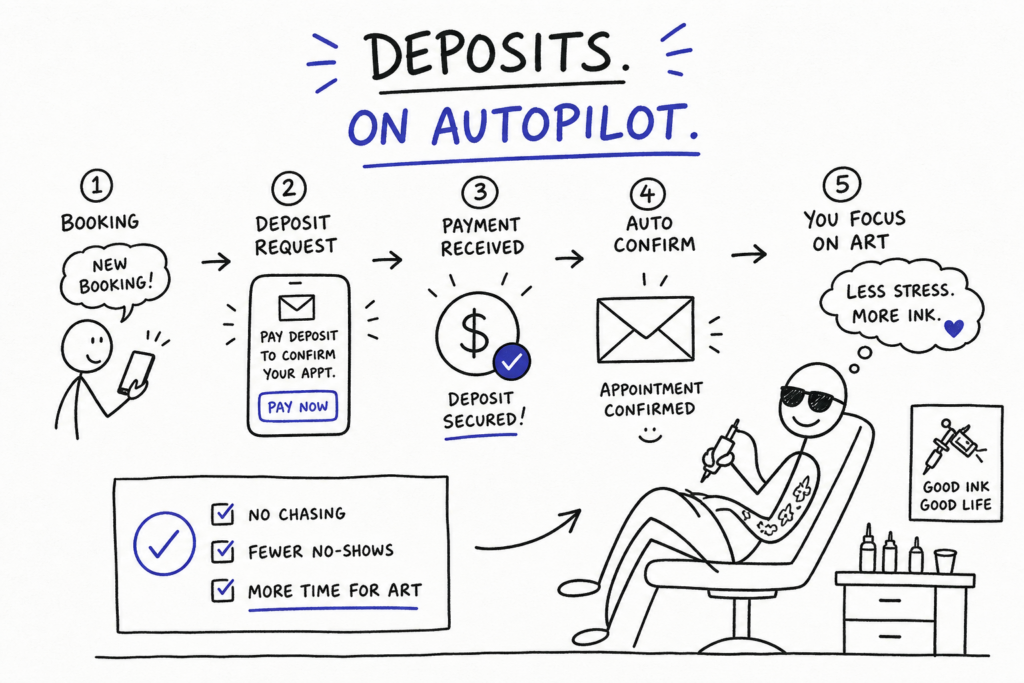
The ideal customer deposit workflow looks like this: the client selects a time slot, receives an instant booking confirmation with a secure payment link, pays the deposit online, and gets an automatic receipt. No back-and-forth messages, no chasing. Platforms that integrate the payment step directly into the booking confirmation consistently show higher deposit completion rates than those relying on separate invoices or manual follow-ups, because every additional step between “I want to book” and “booking confirmed” is a step where someone drops off. Many enterprise and mid-market systems document required deposit flows, see NetSuite’s required deposit workflow for an example of how a booking platform can enforce deposits automatically NetSuite’s required deposit workflow.
Deposit workflow step two: managing records between booking and appointment day
Keeping clear records without spreadsheets
Once a deposit is collected, it needs to live in a system that every relevant person in the studio can access. At minimum, that record should include the client’s name, the amount paid, the date it was collected, which appointment it’s linked to, and how it applies to the final total. A sticky note on the desk or a notification in a personal bank app doesn’t cut it, especially in a multi-artist shop where the person who took the booking isn’t always the one running checkout.
Good deposit records also protect you legally. If a dispute arises, you need a timestamped record showing when the deposit was paid, what the client acknowledged at the time of booking, and what the agreed terms were. That documentation is only possible when your records are structured and consistent from the moment payment is made.
Handling reschedules, cancellations, and partial refunds
This is where informal systems collapse under pressure. The clearest policy most studios use is straightforward: deposits are non-refundable but transferable to a rescheduled appointment, provided the client gives at least 48 hours notice and the reschedule happens within a defined window. That policy needs to be in writing and acknowledged by the client at the point of booking, not explained during an emotional cancellation call.
Your written policy should address at least these scenarios: last-minute cancellations, where the deposit is forfeited; no-shows, where the deposit is forfeited and a new deposit is required to rebook; and artist-initiated reschedules, where the deposit transfers automatically with no penalty to the client. Cover a fourth scenario too, partial sessions or work that runs significantly short, so you’re not improvising a policy on the spot. Having each scenario written out in advance removes the emotional negotiation from the conversation and gives you a consistent answer regardless of who handles the call. For practical strategies on enforcing deposits while keeping clients, see how tattoo studios reduce no-shows without losing clients.
Deposit workflow step three: applying the deposit at checkout
Closing the financial loop on every session
By the time the client sits in the chair, the deposit should already be recorded against the appointment in your system. At checkout, three numbers need to be visible: the total session cost, the deposit already credited, and the remaining balance the client owes. That calculation should happen automatically. When it’s done from memory, errors creep in, particularly on sessions that ran longer or shorter than estimated.
For multi-session projects, the same logic applies at each checkout. The deposit typically applies at the first session, with subsequent sessions settled in full. Whatever the arrangement, the deposit record needs to follow the appointment, not sit in a separate spreadsheet that gets checked inconsistently.
Reconciling deposits across artists and appointments
In a studio running multiple artists, end-of-day deposit reconciliation matters. A solid deposit reconciliation workflow lets you confirm that every deposit collected was applied correctly at checkout, that no appointment closed without accounting for the deposit, and that any outstanding balances are flagged rather than missed. This doesn’t require a manual audit of every record. It requires a consistent daily report that surfaces anomalies automatically, so you’re resolving one flagged item rather than reviewing thirty appointments from scratch.
Studios that use dedicated booking software can typically export deposits to QuickBooks or their accounting tool of choice, making the bank deposit procedure and end-of-month reconciliation significantly faster than piecing it together from memory and scattered records. Some providers also publish step-by-step guides for exporting deposits from desktop products, see this walkthrough on how to export deposits from QuickBooks Desktop if your studio uses a desktop accounting workflow.
How Tattoogenda automates the entire deposit workflow end-to-end
From booking link to checkout in a single platform
Tattoogenda was designed specifically for tattoo and piercing studios that were running exactly the kind of fragmented deposit process described above. When a client books through a Tattoogenda-powered booking link, the platform requests the deposit as part of the confirmation flow. The client selects their slot, pays securely online, and receives an automatic receipt. The deposit is logged against the appointment and visible to every artist and front desk staff member in the studio calendar.
There’s no manual entry, no separate payment link to send, and no chasing. The artist sees the deposit status before the client even walks through the door. At checkout, the platform applies the deposit to the final total automatically, showing the client exactly what they paid upfront and what the remaining balance is. The entire deposit operations workflow, from booking link to final checkout, runs as a single connected process.
The no-show protection that runs in the background
Tattoogenda’s reminder system runs on every appointment. Automated SMS and email reminders go out at configurable intervals before the session, reducing the chance of a forgotten appointment. If a client cancels last minute or doesn’t show, the deposit policy they acknowledged at booking is already on record. No difficult conversation required, the terms were set before the appointment existed. The platform’s built-in no-show protection helps studios enforce those terms consistently.
For multi-artist studios, deposit reconciliation becomes straightforward. Every deposit is tracked by artist, by appointment, and by date. End-of-day reporting surfaces any unresolved balances automatically. Tattoogenda is built to handle the deposit workflow without manual intervention, from the moment a client books through to the moment they settle their remaining balance at checkout.
Build the process once, protect your revenue every time
Think back to that artist who lost three hours to a no-show. A working deposit workflow changes that outcome before it ever happens. The client either pays the deposit and shows up, or they don’t complete the booking. Either way, the calendar stays clean and the artist’s time is protected.
The deposit workflow itself is straightforward: collect at booking, manage the record between booking and appointment, and apply cleanly at checkout. Getting those three stages connected, so that what’s collected at the front feeds directly into what’s settled at the end, is the entire goal. Set it up correctly once and the deposit reconciliation workflow, the no-show protection, and the checkout process all run without manual intervention after that.
To see how Tattoogenda handles this in practice, explore the deposit collection: policies, tools & templates and book a walkthrough. The full deposit workflow, from booking link to final checkout, is already built and ready to run.

 English
  Dutch
Dutch  Dutch (Belgium)
  French
  German
  Spanish