
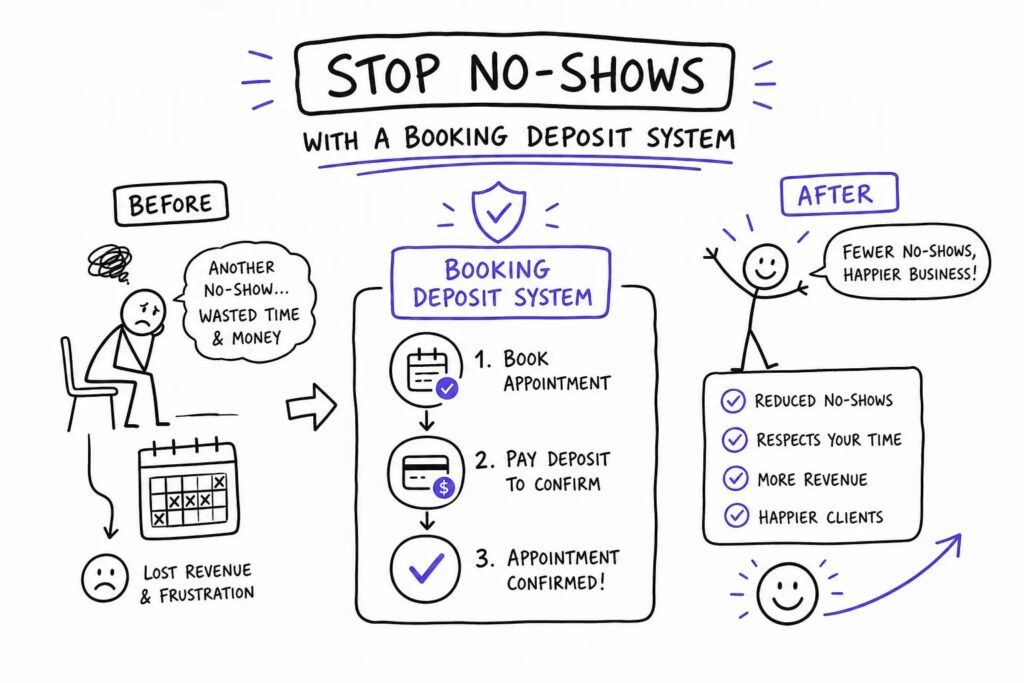
You blocked four hours, sketched the design, prepped your station, and then waited. No call, no text, no client. That appointment slot is dead revenue, and if it happens twice a week, it adds up to thousands of dollars a month walking out the door before a single needle touches skin. A booking deposit system is the most direct fix: studios without a deposit requirement see no-show rates averaging 15, 25%, and for long custom sessions booked weeks out, that number can climb closer to 30%. Studios that require upfront payment consistently report dropping those rates to 5, 7%. That difference is not luck. It is a system.
This guide covers everything you need to build that system: the right policy structure, the right platform, and clear language that keeps the conversation from feeling awkward with clients. Platforms like Tattoogenda have deposit collection built directly into the booking flow so it runs automatically, but the principles here apply regardless of which tool you choose.
Why the data backs deposit-required bookings
A ghost appointment costs more than one lost session. During peak hours, a no-show blocks a slot that a paying client could have taken, wastes the prep time the artist already put in, and compounds over weeks into serious lost revenue. For multi-artist shops, every empty chair multiplies that loss across the whole floor.
Studios requiring deposits see average no-show rates of 5, 7%, compared to 12, 18% for free-to-book schedules. Industry summaries often report no-show reductions in the range of 50, 60% after introducing a deposit requirement, and Booksy has reported a roughly 20% drop in cancellations when deposit protection was active on its platform. Industry data consistently shows that when clients have money on the line, last-minute no-shows drop and earlier cancellations rise, both outcomes improve your rebooking opportunities.
Tattoo appointments are especially high-risk for no-shows because the sessions are long, the slots are nearly impossible to fill on short notice, and the revenue per appointment is significant. A two-minute no-show on a four-hour custom piece is far more damaging than a missed haircut. The deposit is not just a payment. It is an appointment lock that signals to the client that this time belongs to them, and that commitment runs both ways.
What a booking deposit system policy needs to cover
Most studios in the U.S. charge a flat deposit fee in the range of $50, $200, with the most common amounts clustering around $50, $100 for standard sessions and scaling higher for large or multi-session work. A flat fee beats a percentage for client clarity: “your deposit is $100” is simpler than “your deposit is 25% of an estimate I haven’t finalized yet.” The deposit should feel meaningful enough that clients stay committed, but not so high that it becomes a barrier to booking in the first place.
Nonrefundable deposits with a rescheduling window are the industry standard for good reason. Clients who cancel with at least 48, 72 hours notice can reschedule and carry the deposit forward to their new date. Clients who ghost or cancel same-day forfeit it. Define both scenarios in writing before you collect a single payment, ambiguity is where disputes start.
The other piece clients ask about most: where does the deposit go? Most studios apply it toward the final session price, not as a separate charge on top. Make this explicit in your policy and in your confirmation messages. Once clients understand they are not paying extra, the main objection disappears before it ever comes up. When your deposit terms appear in the booking flow, the confirmation email, and the automated reminder, clients will rarely push back because nothing comes as a surprise.
Building a booking deposit system that runs without you watching it
Getting a deposit collected is straightforward. Getting it collected automatically, every time, without manual follow-up, is where the right platform makes the difference. The discipline is in setting up the workflow correctly and not making exceptions that quietly undermine the policy over time.
Tattoogenda is built specifically for tattoo and piercing studios, and deposit collection is woven directly into the online booking flow. When a client selects a service and artist, they are prompted to pay the deposit before the appointment is confirmed. The platform connects this to automated SMS and email reminders so the deposit and the reminder system work together as one no-show prevention workflow, not two separate tools you have to configure and sync. For multi-artist shops, deposit rules can be applied across all artists or customized per service or chair, which matters when your guest artist rates differ from your resident artists. Check Tattoogenda’s product documentation for current feature specifics and configuration options.
Square Appointments supports deposits for both all services and selected services when clients book online. It does not support deposits when you manually book on behalf of a client, so self-serve online booking is required for the feature to work. Square’s invoice system also allows a deposit plus a payment schedule for larger projects, according to Square’s documentation, this works well for sleeve consultations or multi-session commitments. The processing fee is 2.9% + $0.30 for online transactions.
Acuity Scheduling and SimplyBook.me both support upfront payment requirements at booking, connecting through Stripe or Square as the payment processor. They work for general service businesses and can be configured for tattoo shops, but they require more manual policy setup and generally lack native tattoo-industry features compared with purpose-built platforms, things like digital consent forms, ink passports, and client history tracking. If your studio is already running on one of these and wants to add deposit functionality, they are usable. For a shop building its booking deposit system from scratch, a purpose-built platform handles more of the workflow automatically and with less ongoing configuration.
Before committing to any appointment deposit software, ask these questions:
- Does deposit collection happen automatically at booking, or does it require manual follow-up?
- Does the platform connect directly to your payment processor, or does it add its own transaction fee on top of the processor’s rate?
- Can you apply deposit rules per service type or per artist, or only globally?
- Does the platform include a built-in no-show and cancellation workflow, or do you enforce policy manually?
What payment processing fees actually cost your studio
Processor fees
Stripe and Square both charge 2.9% + $0.30 per successful online card transaction in the U.S. On a $100 deposit, that is $3.20 in processing fees. For a studio collecting 80 deposits a month, that is roughly $256 in fees every month, a number worth factoring into how you price services and structure your deposit amount.
Platform fees and total cost per booking
Processing fees are only part of the cost picture. The booking platform itself typically charges a monthly subscription fee on top of the processor’s rate, and some platforms also add a per-transaction fee. Calculate the total cost per booking: processor fee plus platform overhead. A studio-specific platform that bundles deposit collection with automated reminders, consent forms, and client history often costs less in total than stitching together three separate tools that do not talk to each other.
One more distinction worth understanding: authorization holds versus immediate charges. Some prepayment booking systems authorize a card at booking and capture the payment later, rather than charging immediately. According to Stripe’s developer documentation, standard authorization holds last seven days, with extended holds up to 30 days for eligible businesses. For tattoo studios with appointments scheduled weeks or months out, an immediate charge at booking is usually the cleaner setup and avoids the risk of an expired hold and a client who no longer has the card on file.
Keeping your deposit policy legal and clear in the U.S.
U.S. consumer protection standards require that deposit terms be visible and agreed to before a client pays. That means stating the amount, whether it is refundable, the cancellation window, and what triggers forfeiture. The policy should appear in the booking flow, the confirmation email, and any receipt. A checkbox or affirmative agreement step at booking documents acceptance cleanly, and that record matters if a dispute ever surfaces. Note that specific requirements can vary by state, so it is worth checking the rules that apply to your location.
Keep the fee reasonable and defensible. No-show fees that equal the full service price for work not yet performed are generally difficult to defend under consumer protection guidelines. A reasonable deposit, clearly described as a reservation fee or nonrefundable booking fee, is far easier to uphold if a client files a chargeback. The best protection against a chargeback is documentation: a signed or digitally acknowledged policy, a confirmation email with the terms included, and a timestamped record of the booking and any client communication. Platforms that store this automatically give studios a clear paper trail without extra admin work on anyone’s part.
On the tax side, the practical distinction is between a refundable deposit and a nonrefundable fee. A forfeited nonrefundable deposit is generally treated as income when forfeited. A refundable deposit is not recognized as revenue until the service is delivered or the deposit is kept. Because the characterization depends on how your policy is written and how you run your books, confirm the handling with a CPA, your booking language should match your intended accounting treatment.
How to talk about deposits with clients without losing bookings
Your deposit policy should appear in three places: the booking flow before payment is requested, the confirmation email, and the automated reminder. When all three mention the deposit terms consistently, clients rarely push back because the expectation was never a surprise. Consistency across every touchpoint is what turns a policy into a standard part of the client experience.
Language matters more than most studio owners realize. Avoid framing the deposit as a penalty for potential bad behavior. Position it as how your studio secures the artist’s time specifically for that client’s session. “A $100 deposit holds your appointment and is applied to your session total” reads very differently than “We require a deposit because of past no-shows.” The first communicates value and commitment. The second signals distrust before the relationship even starts. When your booking system sends this language automatically with every confirmation, the policy becomes part of your client experience rather than an awkward conversation at the front desk.
Clients who understand that the deposit is part of a professional process, not a punitive measure, almost never object. The studios that see the most friction around deposits are usually the ones communicating the policy inconsistently or too late in the booking process. Get the message right, put it in the right places, and let the system deliver it every time.
Putting your booking deposit system to work
A well-structured booking deposit system does not have to be complicated. Solid policy, a payment-enabled booking platform that collects deposits automatically, and consistent client communication are what move a studio from a 15, 25% no-show rate down to something closer to 5, 7%.
If you are starting from scratch or want to replace a patchwork of separate tools, a studio-specific platform like Tattoogenda handles the full workflow automatically. The deposit is collected at booking, the reminder goes out on schedule, and the no-show protection runs in the background while your artists focus on the work. Reach out to the Tattoogenda team to see how the deposit and reminder workflow fits your shop’s setup. Get the policy right first, then let the right tool make it effortless.

 English
  Dutch
Dutch  Dutch (Belgium)
  French
  German
  Spanish