
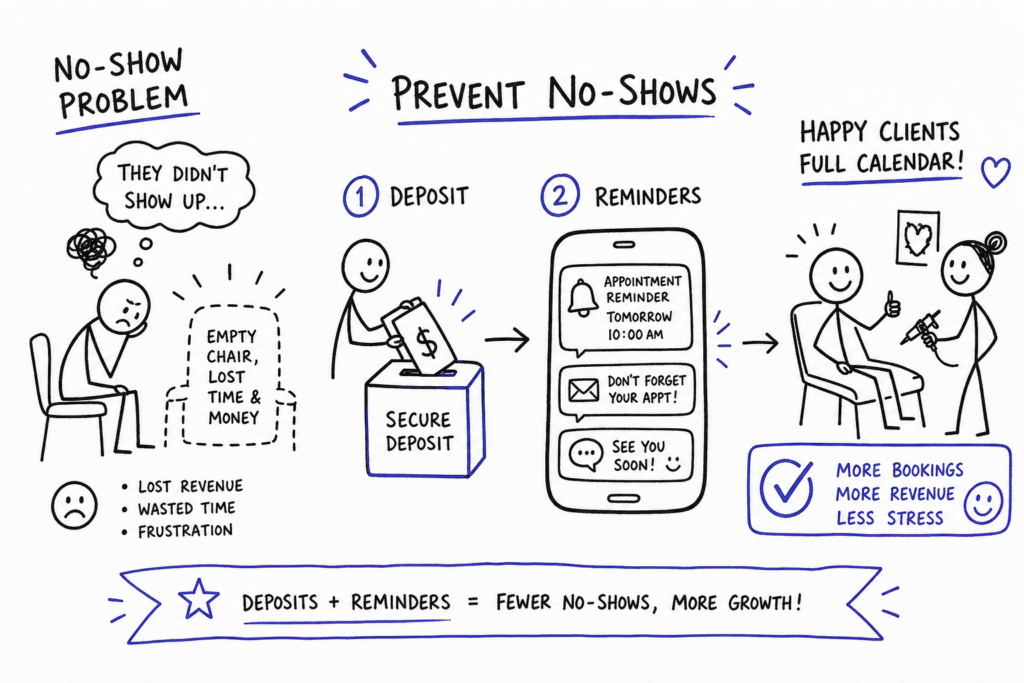
Tattoo no show prevention is the unglamorous side of running a studio that nobody talks about until a four-hour custom slot evaporates at 9am on a Tuesday. No-show rates are commonly cited anecdotally at anywhere from 10 to 30 percent, studios should check their own booking analytics for an accurate number, because the spread is wide and the cost is real. The studios winning this fight all use the same three-part system: a deposit-first booking process, a 3-1-0 reminder cadence, and a written policy with teeth. Tattoogenda was built to automate every piece of that system so you can stop chasing confirmations and start tattooing.
This is the complete playbook. You’ll walk away with deposit amounts, reminder scripts, policy language, tracking metrics, and a clear picture of the tools that handle the heavy lifting for you.
Build a deposit-first booking system for tattoo no show prevention
Choose the right deposit amount
The deposit amount needs to create genuine financial investment, not just a formality. For flash work or small pieces, a flat $50 to $100 deposit works well and keeps the process simple for both sides. For custom designs or full-day sessions, use 25 to 50 percent of the estimated total, or a flat fee equal to one hour of the artist’s rate. That structure scales with the risk: a four-hour back piece carries more lost revenue than a wrist piece, so the deposit should reflect it.
A meaningful deposit changes client behavior; a token amount does not. Studios that have raised deposits from token amounts to $75 or $100 tend to report a drop in casual cancellations, the principle is straightforward: clients who have real money on the line show up.
Make deposits non-refundable, with fair reschedule rules
Non-refundable does not mean inflexible. The standard that works is this: a client who gives 48 hours’ notice keeps their deposit as a credit, valid for 12 months. Anyone who cancels with less than 48 hours’ notice, or simply doesn’t show, forfeits the deposit entirely. Adding a limit of two reschedules per booking before a new deposit is required is a widely recommended best practice, adjust based on your local norms and consult applicable legal constraints (see the tattoo deposit guide). A clause that arriving more than 15 to 20 minutes late may result in a shortened session or forfeiture rounds out the protection. These limits protect your calendar from the chronic rescheduler who never actually sits.
Collect deposits seamlessly online
The booking link should require payment before a slot is confirmed. No payment, no appointment. This removes any awkward in-person conversation about money and keeps the process clean. Tattoogenda ties the deposit directly to the appointment and the client record, so the amount auto-applies at checkout on tattoo day without any manual reconciliation. The client pays once, and the system tracks it from booking to session close. Learn more about how we collect deposits and apply them to bookings.
Post the policy everywhere clients look
Consistent visibility is what makes a policy enforceable. Put the deposit and cancellation terms on your website, your booking page, your DM auto-reply, consultation emails, and your digital consent forms. Staff should also repeat the key points verbally during consultations and note that acknowledgment in the CRM. When a dispute arises, your time-stamped records do the talking.
Reminders for tattoo no show prevention
Run a 3-1-0 cadence
Send three reminders: three days before, one day before, and same-day. Each message should include the appointment time, a confirm or reschedule link, and any prep notes the client needs. The three-day message is the right place to remind clients to eat a good meal, stay hydrated, bring a valid ID, and wear clothing that gives access to the area being tattooed. Multi-reminder studies consistently show that adding a second text reduces missed appointments by roughly 7 to 11 percent compared to a single reminder, much of this research comes from healthcare settings, but the behavioral mechanism applies equally to appointment-based service businesses. A same-day message pushes that improvement further. For practical implementation tips, see this appointment reminders guide.
Lead with SMS, support with email and WhatsApp
SMS open rates beat every other channel, most texts get read within minutes of delivery. That makes it the primary channel for every reminder. Email handles the details: maps, prep guides, policy links, and the full appointment summary. WhatsApp fills gaps in regions where it’s the dominant messaging platform. Layering all three channels without being repetitive is the goal. Send the same core message through different formats, not the same message three times through the same channel. For a deeper look at implementing SMS for appointment reminders and confirmations, this resource is useful.
Multi-channel coverage improves reach without overwhelming the client. The client who misses an SMS often catches the email, and vice versa.
Make confirmations two-way
One-way reminders are better than nothing. Two-way reminders are dramatically better. Ask the client to reply YES to confirm or tap a link to reschedule. Set a cutoff, typically noon the day before, and auto-cancel the slot if no confirmation arrives by then. Releasing an unconfirmed slot early gives your waitlist time to fill it. Healthcare clinics that have added two-way confirmation to their reminder workflows have reported no-show rate reductions exceeding 60 percent in some cases; the underlying mechanism is the same for any appointment-based business, tattoo studios included. If you need a step-by-step on how to implement them, read How to set up automated text reminders for tattoo shops, tattoogenda.com.
Reduce lead time and add prompts
Booking windows matter. No-show rates roughly triple between same-week and month-out bookings. Where your waitlist and workflow allow, shortening the gap between booking and appointment reduces attrition. Sending a “tap to pick a time” prompt when a slot opens also removes the friction of starting from scratch. The easier you make it to commit, the more often clients do.
Your tattoo appointment policy, clear and enforceable
The 48-hour reschedule window and late arrival rules
Your written policy should state the 48-hour reschedule window plainly: notice given at least 48 hours before the appointment allows the deposit to transfer to a new date. Notice given less than 48 hours before, or no contact at all, results in forfeiture. Include a late arrival clause that specifies what “late” means in your studio, usually 15 to 20 minutes, and what happens as a result. Document any accessibility exceptions you offer, and note them in the client record so your team handles them consistently.
No-show fee and deposit forfeiture language
State clearly that the deposit is non-refundable and is applied toward the final cost of the completed tattoo. A missed appointment without contact equals full forfeiture. Some studios add a no-show fee on top, typically equal to one hour of the artist’s rate, which is charged before a rebook is accepted. Whether you use that fee or not, the policy language should name the specific conditions under which money is lost.
Specific conditions prevent arguments. Vague language invites them. Every dollar-amount and time-window in your policy is a future argument you won’t have to have.
Design revisions and when a new deposit is required
Include two to three minor revisions in the consultation process without penalty. If a client wants a major redesign or an entirely new concept after the artist has already spent time on the original drawing, a new deposit is required and the original is forfeited as payment for that time. This protects artists from spending hours on artwork for clients who aren’t serious about committing to a specific design.
Client acknowledgment and visibility
The policy is only enforceable if the client has seen it and confirmed they understood it. Digital consent forms with a checkbox acknowledgment and a date-stamped signature are the cleanest solution. Tattoogenda stores these records in the client history so any team member can pull them up instantly if a dispute arises. Post the policy on your booking page, include it in the confirmation email, and keep it visible in your studio.
Automation for tattoo no show prevention
Tattoogenda’s no-show fixer and automated reminders
Tattoogenda’s no-show fixer handles the entire reminder and follow-up cycle without manual work. It auto-sends the 3-1-0 SMS and email sequence, requests confirmations, logs replies, and triggers no-show workflows when clients don’t respond. If someone misses their appointment, the system can message them, apply the policy automatically, and walk them through rebooking with a deposit top-up. You set the rules once; the software enforces them every time.
Waitlists and instant gap filling
Every cancellation is a potential filled slot, if you move fast enough. Tattoogenda maintains a live waitlist and automatically offers open times to the best-matched clients, with a one-tap SMS claim. A late cancellation that used to mean dead chair time becomes a filled booking within minutes. For multi-artist studios, that recovered time adds up fast across a full week’s calendar.
What to look for in booking software
If you’re evaluating options, the non-negotiable features are deposit collection tied to appointments, two-way SMS with logging, digital consent forms, a CRM that stores client history, and analytics that show no-show rates by artist and time slot. Other generalist booking platforms cover the basics, but they’re built for salons and medical offices, not for studios tracking ink passports, managing multi-session custom work, and collecting design revision notes. Read more about how a tattoo booking app can boost bookings and map to your studio workflow.
Scripts for every moment: confirm, remind, recover
Deposit confirmation and policy receipt
Send this immediately after booking: “Thanks, [Name]. Your [Date] at [Time] with [Artist] is confirmed. Your deposit has been received and will be applied at your session. Our full policy is here: [link]. Reply if you have any questions.” Short, clear, and sets expectations from the start.
Reminder scripts for the 3-1-0 cadence
Three days out: “Hi [Name], your tattoo session with [Artist] is on [Date] at [Time]. Eat well, stay hydrated, and wear clothing that gives access to the area. Bring a valid ID. Questions? Reply here.”
One day out: “Hey [Name], your appointment is tomorrow at [Time]. Reply YES to confirm or tap here to reschedule: [link].”
Same-day: “We are set for [Time] today, [Name]. Reply here if you need directions or have any last-minute questions. See you soon.”
Missed appointment follow-up
Send this two to four hours after the missed slot: “Hi [Name], we noticed you weren’t able to make it today. We hope everything is okay. When you’re ready to rebook, here’s a quick link: [link]. Your deposit status is [applied/forfeited per policy]. Let us know if you have questions.” Empathetic, factual, and action-oriented. For concrete message templates you can adapt, consult this no-show email sample.
Kind and clear messages recover more clients than punitive ones. Most no-shows are accidental. Your tone determines whether that client comes back.
Rebooking offers with boundaries
If a client wants to rebook after a no-show, offer two or three specific available times rather than asking them to browse the calendar from scratch. If your policy requires a deposit top-up before rescheduling, state it plainly: “To secure your new slot, we’ll need [amount]. Here’s the link to complete that: [link].” Keep the tone warm and the process simple, and most clients will follow through.
Track no-shows and tighten your calendar over time
Core metrics to watch weekly
Pull these numbers every week: no-show rate by artist and time slot, confirmation rate from reminders, waitlist fill rate, deposit forfeiture rate, and revenue recovered from filled cancellations. These five metrics tell you exactly where your system is working and where it needs adjustment. Tattoogenda’s analytics dashboard surfaces all of them without manual spreadsheet work.
Team habits that keep it tight
A daily noon check of the next day’s confirmation queue prevents surprises. End-of-day audits catch anything the system flagged. Save all reminder scripts as canned replies so every team member sends the same message. Route policy disputes to the manager immediately, with the CRM record pulled up before the conversation starts. Consistent habits are what turn a good system into a great one.
Monthly review checklist
Once a month, pull your Tattoogenda analytics, adjust deposit thresholds if certain slot types are showing higher forfeiture rates, review any policy disputes and refine the language, and update your reminder scripts if response rates have dropped. Track the improvement in your no-show numbers and use it to justify the next system upgrade, a meaningful drop in no-show rate is real revenue recovered, and that data belongs in your business case.
Put tattoo no show prevention to work today
The full tattoo no show prevention system comes down to four things: collect a meaningful deposit at booking, run the 3-1-0 two-way reminder cadence, publish a written policy that clients acknowledge and sign, and automate all of it so none of it depends on someone remembering to send a text. Every piece is straightforward on its own. What makes the difference is running them together, consistently, on every appointment.
Tattoogenda’s no-show fixer handles the reminders, the confirmations, the waitlist fills, and the policy enforcement automatically. If you’re still chasing clients manually, turn it on today and let the software do the chasing. Your artists’ time is better spent behind the machine.

 English
  Dutch
Dutch  Dutch (Belgium)
  French
  German
  Spanish