
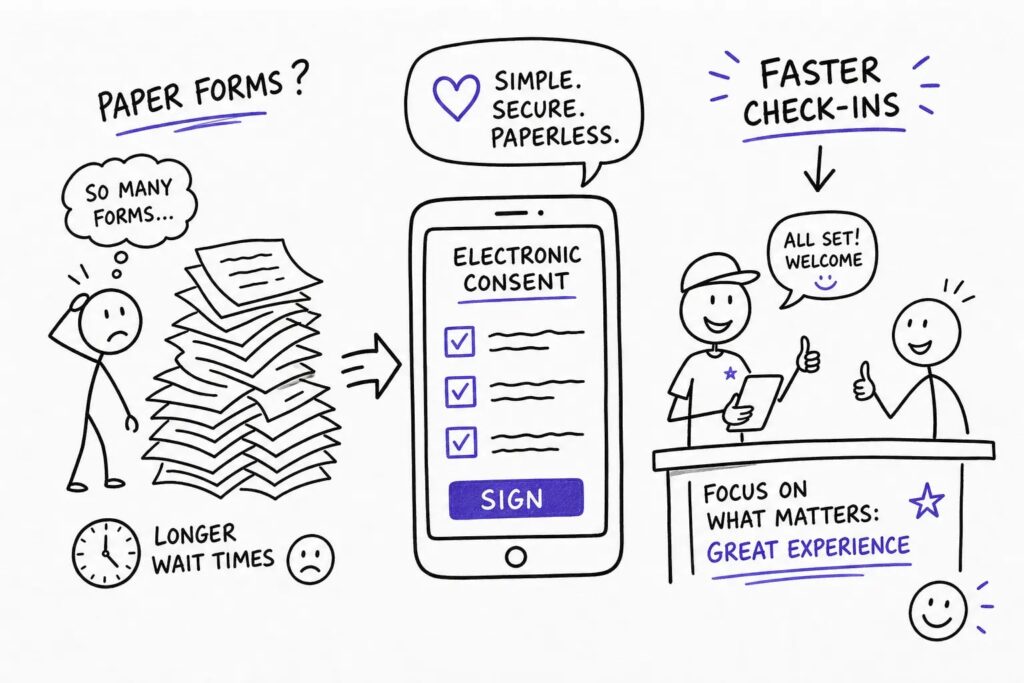
The client walks in, the artist is gloved up and ready, the stencil is placed. Then someone hands over a clipboard and a pen, and everything stops. To avoid that clipboard delay, studios that stay ahead of the curve send an electronic consent form the moment a booking is confirmed, so the paperwork is done before the client arrives. With paper, medical questions get skipped, signatures get scrawled in ways that invite dispute, and the signed document often ends up in a manila folder that no one can locate six months later when they actually need it. That stack of consent forms in the back of the studio isn’t just clutter, it’s lost time, liability exposure, and a compliance problem sitting quietly until it isn’t quiet anymore.
Forward-thinking shops are making a straightforward switch: sending digital consent forms before the client walks through the door. The signed document lands in the client’s record automatically, no chasing, no reprinting, no illegible handwriting to decode. Tattoogenda was built specifically for this workflow, giving tattoo and piercing studios an e-form builder that connects directly to the booking process so the paperwork side of the business runs without manual effort from the team.
The real cost of paper consent forms in a busy studio
The problem with paper consent forms isn’t just that they’re old-fashioned. It’s that the operational drag compounds across every appointment, every artist, and every location. At the front desk, each new client adds several minutes of intake time that eats directly into the artist’s session. Multiply that across a full day of bookings and the cost becomes significant before anyone notices it accumulating.
When a stack of paper becomes a liability
Lost forms are a real risk in paper-based studios, and the consequences go beyond inconvenience. If a client experiences an allergic reaction or files a complaint and the studio cannot produce a signed consent form, there is no evidence that the risks were disclosed. State health departments in the U.S. require studios to retain client consent records for periods that vary widely by state, commonly ranging from one year to several years, and missing records during an inspection can trigger violations. A signed paper form that gets water-damaged, misfiled, or simply discarded by accident turns a manageable situation into a real legal exposure.
Handwritten forms also create their own problems. Paper intake increases the risk of skipped fields, illegible entries, and signatures that could be disputed. The “known allergies” field gets left blank because the client was in a hurry. An electronic consent form reduces incomplete submissions by enforcing required fields, so clients are far less likely to move past a mandatory question the way they routinely skip lines on paper.
The front-desk bottleneck no one talks about
Picture a Friday afternoon: three clients arrive within fifteen minutes of each other, two artists are waiting, and the one person managing the front desk is handing out clipboards while trying to answer the phone. Appointments run five minutes long, then ten, and suddenly the 3:00 slot bleeds into 3:20. The next client gets bumped, the artist loses flow, and the studio’s reputation for running on time takes a small hit that adds up over weeks and months.
Much of this bottleneck is preventable. When a digital consent form goes out the moment a booking is confirmed and the client completes it from their phone before arriving, check-in shrinks to a brief greeting. The form is already signed, timestamped, and saved. The artist can start on time.
What a proper electronic consent form captures for tattoo and piercing clients
Before going digital, studios need a clear picture of what the form actually needs to include. A well-built online consent form for a tattoo or piercing studio covers more ground than a basic liability waiver, and it protects both the client and the studio when it’s done right.
Core fields every tattoo or piercing consent form should cover
The essential sections of an electronic consent form include client identity and date of birth for age verification, government ID acknowledgment, a description of the specific procedure and placement, medical history disclosures, and a detailed allergies section covering inks, metals, latex, adhesives, and topical products.
Studios should also capture current medications, particularly blood thinners and immunosuppressants, pregnancy or breastfeeding status, a history of keloid scarring or skin conditions, and any fainting or seizure history. The aftercare acknowledgment section closes the loop by confirming the client received and understood the care instructions specific to their procedure.
For piercing studios, the metals and allergy section carries extra weight, since nickel sensitivity is among the most common causes of post-piercing complications. Building these fields directly into the digital consent form, with required completion before submission, means the artist has the full picture before the session begins rather than finding out partway through.
Why capturing medical history digitally matters more than you think
A digital consent form connected to a client’s profile does something paper never could: it carries that health information forward to future appointments. When a returning client books their third session, the artist doesn’t need to re-ask the same medical questions from scratch. The disclosures from previous visits are already in the record, flagged alongside appointment notes and session history.
This is where the concept of an ink passport becomes genuinely useful. In Tattoogenda, signed consent forms live alongside healed photos, artist preferences, and session notes inside the client’s full profile. The ink passport turns a one-time transaction into a living client record that makes every future visit more informed and more efficient for everyone involved.
How an electronic consent form accelerates the whole check-in experience
Studios that implement digital consent commonly report faster check-ins, fewer delays at the start of sessions, and a noticeably more professional first impression for new clients. The workflow shift is concrete, and it starts the moment a booking is confirmed.
Sending the electronic consent form before the appointment eliminates the wait
Once a booking is confirmed, an automated message goes out to the client with a link to their digital consent form. They complete it on their phone at home, on the bus, or sitting in the parking lot before they walk in. By the time they reach the front desk, the document is already signed, timestamped, and attached to their appointment in the system. Check-in becomes a greeting, not an administrative task.
The federal ESIGN Act supports this workflow by establishing that an electronic signature carries the same legal weight as a handwritten one, provided the client has the opportunity to access and retain the signed document and the process makes their intent to sign clear. A properly built eConsent platform handles all of that automatically, so the studio gets both speed and legal validity without trading one for the other.
Walk-ins and same-day sessions without the clipboard scramble
Walk-in clients are where paper forms create the most friction, because there’s no advance notice and no time to prep. With a digital consent system, a QR code at the front desk or a tablet mounted at the reception area launches the form instantly. The client fills it out in a few minutes while the artist sets up the station, and the signed document is stored before the session begins. No clipboard, no pen borrowing, no hunting for the right form template.
For studios that do a high volume of walk-in piercing appointments, this matters especially. Piercing sessions are often shorter than tattoo sessions, which means the intake process represents a larger share of total appointment time. Cutting that time down has a direct effect on how many clients the studio can serve in a day.
Security and storage: protecting your studio long-term
Digital doesn’t just mean convenient. Done correctly, it means more secure, more defensible, and more durable than anything a filing cabinet can offer. The right electronic informed consent approach protects the studio whether an issue arises tomorrow or three years from now.
Encrypted storage and tamper-evident records
A properly built e-consent system stores signed documents with timestamps, signature records, and version information that makes unauthorized alteration detectable after the fact. If a client or their representative ever questions what was agreed to before a session, the studio has a clean, retrievable record showing exactly what form was presented, when it was signed, and what the client acknowledged. That’s a fundamentally stronger position than a paper form that could be disputed, damaged, or simply claimed as missing.
Encrypted storage also protects the sensitive medical and personal information clients disclose on consent forms. Health disclosures, medication lists, and allergy details are exactly the kind of data that needs to be handled carefully, both for the client’s privacy and for the studio’s compliance posture.
Access controls and retention policies that scale with your shop
Role-based access lets studios configure which staff members can send and receive forms versus who controls record deletion and export. For multi-artist shops or studios that host guest artists on rotation, configurable permission levels help prevent records from being accessed or modified by people who shouldn’t be touching them. They also create a clean audit trail showing who accessed which documents and when.
Long-term retention is something paper studios often handle inconsistently, because maintaining organized physical files for years across hundreds of clients takes discipline and physical space. A digital system makes retention automatic. The records stay organized, searchable, and accessible without depending on a filing system that nobody has time to maintain properly.
How Tattoogenda’s e-form builder makes this simple for any studio
Tattoogenda wasn’t adapted from a generic form tool. It was designed with the specific workflow, compliance considerations, and client experience of a tattoo or piercing shop in mind, and that context shows up in how the e-form builder actually works.
Build, brand, and send consent forms without technical skills
The form builder uses a drag-and-drop interface with customizable sections for different service types: tattoo, piercing, touch-up, and any combination the studio offers. The studio’s branding can be applied so the form looks like a professional part of the client experience rather than a generic third-party waiver. There’s no coding involved, no outside tools to integrate, and no starting from a blank document.
Electronic consent form connected to every client’s full profile
Signed consent documents in Tattoogenda attach directly to the client’s profile alongside their appointment history, ink passport, session notes, and artist preferences. When an artist pulls up a returning client before a session, the consent history is visible right alongside everything else. This is the practical difference between a digital filing cabinet and a true client management system built for how studios actually work.
Automated delivery tied to the booking workflow
Tattoogenda’s booking flow triggers the remote consent request at the right moment in the client journey, without any manual follow-up from staff. The client receives a message, completes the form on their phone, and the studio’s record updates automatically. No chasing down signatures, no reprinting forms that got lost, no last-minute scramble at the front desk when the next appointment is already waiting.
Make the switch before the next appointment
An electronic consent form isn’t just a digital version of the paper one. It’s a faster check-in, a stronger client record, a more defensible document, and one fewer thing for studio staff to manage manually every single day. The studios pulling ahead in professionalism and client experience right now are the ones that have automated these friction points instead of accepting them as just how the business works.
Switching doesn’t require a technical overhaul or a long implementation timeline. Think back to that Friday afternoon: three clients at the door, two artists waiting, one person at the desk. With Tattoogenda’s e-form builder connected to the booking workflow, every one of those clients already has a signed electronic consent form on file before they walk in. That’s the version of the afternoon worth running. Reach out to the Tattoogenda team to see the e-form builder in action and find out how fast your studio can go paperless.

 English
  Dutch
Dutch  Dutch (Belgium)
  French
  German
  Spanish