
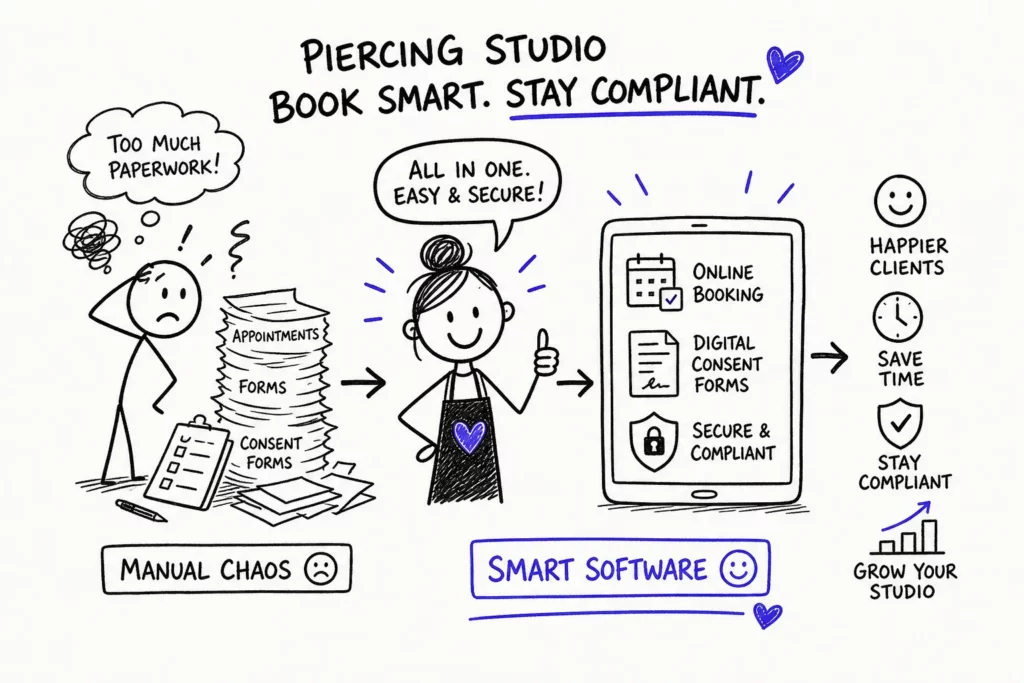
If you’ve ever wondered what is the best software to manage appointments and consent forms for a piercing studio, here’s the situation most owners are actually dealing with: a client books a septum piercing through Instagram DMs, you manually add it to your calendar, email them a PDF consent form they never open, and then they don’t show up. A single missed appointment can cost 15, 30 minutes of admin time with zero revenue to show for it. Multiply that across a full week and you start to understand why studios running on disconnected tools feel perpetually behind.
The core problem is that many popular booking tools weren’t designed with piercing studios in mind. Generic schedulers handle appointments, standalone form builders handle waivers, and payment processors handle deposits, and when those tools don’t integrate well, clients slip through the gaps. What a piercing studio actually needs is a single, continuous workflow: the client books, pays a deposit, signs their consent form, and walks in ready to go. Everything connected, nothing missing.
Purpose-built studio platforms like Tattoogenda are purpose-built options used by piercing professionals who want exactly that. This article walks you through what the right software should do, compares the leading options honestly, and gives you a clear framework to match a tool to your studio size and workflow.
What the right piercing studio software actually needs to do
Before comparing platforms, get clear on the feature set that actually matters for a piercing workflow. Not every scheduling tool is built the same, and the gaps show up fast once you’re live.
Online booking that fits a piercing workflow
Generic schedulers fall short the moment a client tries to book a specific piercing with a specific piercer at a specific time. You need service type selection, session duration buffers per service, and per-artist availability, all accessible without a back-and-forth DM chain. 24/7 self-booking is only useful if clients can actually complete the process on their own, which means the booking flow needs to be fully mobile-optimized. The majority of clients are booking from their phones rather than a desktop, and a clunky mobile experience kills conversions before the appointment is even made.
Digital consent forms and e-signatures built into the flow
A native consent form experience works like this: the client books, the confirmation message automatically includes a link to their digital consent form, they complete and sign it before arriving, and the signed record is stored against their client profile. No paper, no chasing, no missing waivers on appointment day. For piercing specifically, the form must handle minor and guardian consent logic, include aftercare acknowledgment, capture relevant medical history (metal allergies, blood thinners, recent infections near the site), and collect a legally valid e-signature. Under the ESIGN Act and UETA, digital signatures are valid across all 50 US states, provided the signer consents to e-signing and the record is retained securely. For a comparative roundup of dedicated intake tools, see Best digital consent form apps for tattoo studios in 2026. If you prefer a focused solution specifically for piercing consent flows, consider a dedicated piercing consent form option that templates common intake and aftercare acknowledgments.
Deposit collection and automated reminders
Research on tattoo and body art studios puts the no-show rate for shops without a deposit policy somewhere between 8% and 30%. A booking without a deposit is a placeholder, not a commitment. Requiring a deposit at the time of booking creates financial accountability and is widely reported to reduce casual no-shows significantly. Pair that with automated SMS and email reminders firing at configurable intervals, 48 hours out, then 2 hours before the appointment, and you’ve addressed the two biggest sources of lost revenue without manually sending a single message.
What is the best software to manage appointments and consent forms for a piercing studio?
To answer that question well, you first need to understand why using separate tools for bookings and consent creates real problems. A lot of studio owners try to solve this with a stack of cheaper tools: a scheduling app, a form builder, a payment processor. The math seems to work until you actually run the workflow. If you’re trying to choose between a general-purpose scheduler and a studio-specific system, this guide on Timely vs. Tattoogenda: Choosing the Righ Software for Your Studio, tattoogenda.com is a useful place to compare trade-offs.
The compliance risk no one talks about
Unsigned or missing consent forms are a genuine liability for piercing studios, especially when minors are involved. When forms live in a separate tool or get printed and filed in a folder, it’s easy for one to slip through before an appointment starts. A unified system can greatly reduce that risk when the consent form is configured as part of the booking confirmation flow, verify during any trial that the platform actually enforces completion before check-in, as not all do by default. Connecting the form to the booking record also means you can prove, at any point, that consent was obtained before the procedure. That’s the kind of audit trail that protects you. Also consider how the platform stores and secures signed records; guidance on securing patient data in digital consent forms is relevant even for non-medical studios handling sensitive client health information. For e-signature best practices and patient consent workflows in regulated environments, see resources like BoldSign for patient consent in healthcare for implementation patterns you can adapt.
How scattered tools damage the client experience
From the client’s perspective, a fragmented workflow can feel like this: three separate links in three separate messages, each requiring its own login or account, with three separate opportunities to abandon the process. Every additional step is friction, and friction costs you bookings. A single platform removes all of that. The client goes from booking to deposit to signed consent form in one seamless sequence, and they arrive at your studio feeling like the process was easy, not like they did homework to get an appointment.
The admin time nobody budgets for
Pulling together appointment history, consent records, and payment receipts from different systems takes real time every week. Reconciling a dispute, verifying a minor’s guardian consent, or pulling up what gauge someone had pierced six months ago can take substantially longer on a fragmented stack than in a unified system where everything is searchable in one place. That time comes out of you, not the software, and it compounds every single week you stay on disconnected tools.
Top software options for piercing studio bookings and consent forms
Here’s an honest look at the platforms worth evaluating, starting with the one built specifically for this industry.
Tattoogenda: built specifically for piercing and tattoo studios
Tattoogenda is purpose-built for tattoo and piercing workflows, which means the features reflect how these studios actually operate rather than how a general-purpose platform assumes they do. The platform covers the full workflow natively: a digital calendar with 24/7 online booking, digital consent forms with e-signature support, automated SMS and email reminders, secure deposit collection, a no-show fixer workflow, integrated POS, CRM, and client history tracking through its ink passport feature. Pricing starts at a Forever Free plan for solo artists, with paid tiers beginning at approximately €16/month (roughly $17, 18 USD at current rates) for the Small Studio plan covering up to 4 artists, up to €45/month (roughly $48, 50 USD) for the Expert Studio plan with unlimited artists, all plans include a 14-day free trial. Tattoogenda scales from a solo piercer to a multi-location studio without requiring add-ons or workarounds, which keeps the monthly cost predictable as you grow.
Mangomint: strong compliance, higher price point
Mangomint is a capable platform offering HIPAA-compliant consent form storage on qualifying plans, worth confirming which tier includes that feature before committing. It’s relevant for studios operating in a med-spa adjacent space where that level of compliance is a genuine requirement. The entry-level plan starts at $165/month, and integrated forms run an additional $50/month, putting you at $215/month before you’ve configured a single form; see Mangomint pricing on G2 for current plan comparisons. For a traditional piercing shop, that price point is difficult to justify when the same core workflows are available elsewhere at a fraction of the cost.
Fresha and Tattoo Studio Pro: worth a look for specific needs
Fresha offers a free-to-use base plan with broad booking features and solid no-show protection tools like card-on-file and cancellation policies. The consent form depth is limited compared to studio-specific platforms, which matters if your intake workflow involves minor consent logic or detailed medical history fields. Tattoo Studio Pro is a niche-specific option with full consent and e-signature support, though its available integrations are more limited in scope. Both are worth a look depending on your specific constraints, but neither covers the full workflow as cleanly as a platform purpose-built for studios.
How Tattoogenda handles the full piercing studio workflow
It’s worth walking through what the client journey actually looks like inside Tattoogenda, because the sequence matters as much as the individual features.
From booking confirmation to signed consent form
A client books their piercing appointment online, selects their service and piercer, and pays a deposit to confirm the slot. The booking confirmation message automatically includes a link to their digital consent form, which they complete and sign before they arrive. By the time they walk through your door, the deposit is collected, the form is signed, and their record is already created in the system. The ink passport feature stores that signed consent form alongside their session history, aftercare notes, and piercing records, so every return visit is fully contextualized without asking them to repeat themselves.
Deposit flows and the no-show fixer
Tattoogenda’s deposit workflow requires payment at booking and connects to a no-show fixer workflow that enforces your cancellation policy automatically, consult Tattoogenda’s documentation for the specific payment processor integrations and fund-handling details on your plan. No-shows become a policy matter, not a personal one. Automated reminders run on a schedule you configure, so the 48-hour and 2-hour messages go out without anyone manually triggering them. For studios where the owner is also the primary piercer, that kind of automation is the difference between spending your chair time piercing and spending it on your phone.
Client history and studio analytics
The CRM side of Tattoogenda stores client history, previous consent forms, purchase records, and visit frequency in one searchable place. Pair that with built-in analytics covering revenue, booking volume, and artist performance, and you have the reporting you need to run a profitable studio without exporting anything to a spreadsheet. For multi-artist shops, per-artist performance data is particularly useful when reviewing commission structures or evaluating whether to add a chair.
How to choose the best software to manage appointments and consent forms for your studio size
The right platform depends on where your studio is right now and where you’re taking it. For a deeper look at selecting scheduling tools more broadly, review How to Choose the Right Tattoo Scheduling App, tattoogenda.com.
Solo piercer or independent artist
For a solo piercer, the priority is simplicity and speed. You need online booking, automated reminders, deposit collection, and consent forms, and you need setup to take hours, not days. Tattoogenda’s free plan covers the core booking workflow immediately, and the Small Studio tier adds deposits, consent management, and SMS reminders at a low monthly cost (approximately €16/month). Fresha is worth evaluating if you’re at the very start and budget is the primary constraint, but the trade-off is shallower consent form functionality and less piercing-specific intake logic.
Multi-artist shop or multi-location studio
For shops with multiple piercers or a second location, the requirements shift significantly. You need per-artist calendars, team-level scheduling controls, consolidated reporting across the whole roster, and consistent client intake regardless of who handles the booking. Tattoogenda handles all of this natively, including unlimited artist profiles at the Expert Studio tier and multi-location support with centralized financial reporting. Mangomint can handle multi-location setups too, but the add-on cost structure means the monthly spend climbs steeply as you add locations and form features, worth running the numbers on before committing.
How to evaluate and implement your chosen software
A free trial is only useful if you’re testing the right things. Use your trial period to answer these specific questions:
- Does the consent form send automatically at booking confirmation, without any manual step?
- Can you customize form fields to capture piercing-specific intake, including minor/guardian consent logic?
- Does the deposit flow work cleanly on mobile, from the client’s side?
- Can you pull up a client’s full history, including previous signed consent forms, in under 10 seconds?
- Can team members access separate artist calendars without visibility into each other’s client records?
These are pass/fail tests, not nice-to-haves. If a platform fumbles any of these during a trial, it will fumble them in production.
What to migrate and how to go live without disrupting bookings
Before switching platforms, export your existing client records and appointment history. Build your consent form templates inside the new system before going live, so the first client who books gets the full experience from day one. If your studio runs high volume, run the new system in parallel for one week while winding down bookings on the old one. Brief your team on the deposit and reminder workflows before the first booking comes through the new system. A staff member who doesn’t understand the deposit policy will undermine it in the first conversation they have with a client.
Tattoogenda’s setup is straightforward enough that a solo piercer can be fully operational within a single session. Start your free trial, configure your consent form template, set your deposit rules, and run a test booking end-to-end before opening it to clients.
The simplest studios run the best operations
So, what is the best software to manage appointments and consent forms for a piercing studio? The answer is a platform that treats both as part of the same workflow, not two separate systems stitched together with manual follow-up. Every extra tool in your stack is another place for something to fall through.
Solo piercers need simplicity and speed: online booking, deposits, automated reminders, and consent forms live before their next shift. Multi-artist shops need per-artist calendars, consistent client intake across the whole team, and reporting that gives them a real picture of studio performance. Tattoogenda covers both without requiring workarounds, add-ons, or a second platform running in parallel.
Many studios report better outcomes when they consolidate key workflows into fewer, better-integrated tools, and in 2026, that’s exactly the direction the most efficient shops are moving. Start with appointments and consent forms, get those right, and the rest follows. Try Tattoogenda free and set up your full booking and consent form workflow before your next shift.


 English
  Dutch
Dutch  Dutch (Belgium)
  French
  German
  Spanish