

From Finance to Tattooing
Roland Alexandre, born in Metz, France, is a tattoo artist whose journey into tattooing did not begin in an art studio, but in the world of finance. With a Bac+3 degree in finance, he initially worked as a bank advisor for four years. Despite the stability of that career path, something was missing.
Ten years ago, he decided to leave everything behind and follow a different direction—tattooing.
His entry into the industry was intense and fast-paced. Within a single year, Roland completed two apprenticeships in two different tattoo studios, learning the fundamentals of the craft before eventually becoming independent and developing his own artistic voice.
A Youth of Friends, Sports, and Geek Culture
Before tattooing became his profession, Roland’s youth revolved around friendships, sports, and geek culture. He spent much of his time socializing, staying active, and exploring the worlds of movies, games, and pop culture—interests that would later influence the themes in his tattoo work.
Despite choosing a creative career, art was not particularly prominent in his family background. According to Roland, no one in his family was directly involved in the arts, although he does mention that his maternal grandfather was a good drawer.
Learning the Craft
Like many tattoo artists, Roland emphasizes that tattooing is a skill that requires patience and technical discipline.
At the beginning of his career, the priority was mastering the basics—simply learning how to apply ink properly. Once that technical foundation was established, other aspects of the craft began to develop more naturally.
One of the most challenging techniques for him to master was smooth shading. Achieving consistent gradients required extensive experimentation with:
-
Different needles
-
Ink types
-
Machines
-
Voltage settings
-
Wrist movement speeds
Through persistence and constant adjustment, he gradually refined this skill.

Passion That Evolves Over Time
Roland remains deeply passionate about tattooing, although his perspective has evolved since his early years in the industry.
In the beginning, a major focus was building a client base and establishing a reputation. Today, with more experience and confidence, his attention has shifted toward conceptual thinking and aesthetics—ensuring every project reflects the best of what he can create.
For Roland, tattooing is now as much about artistic reflection and project development as it is about technical execution.


A Style Defined by Contrasting Realism
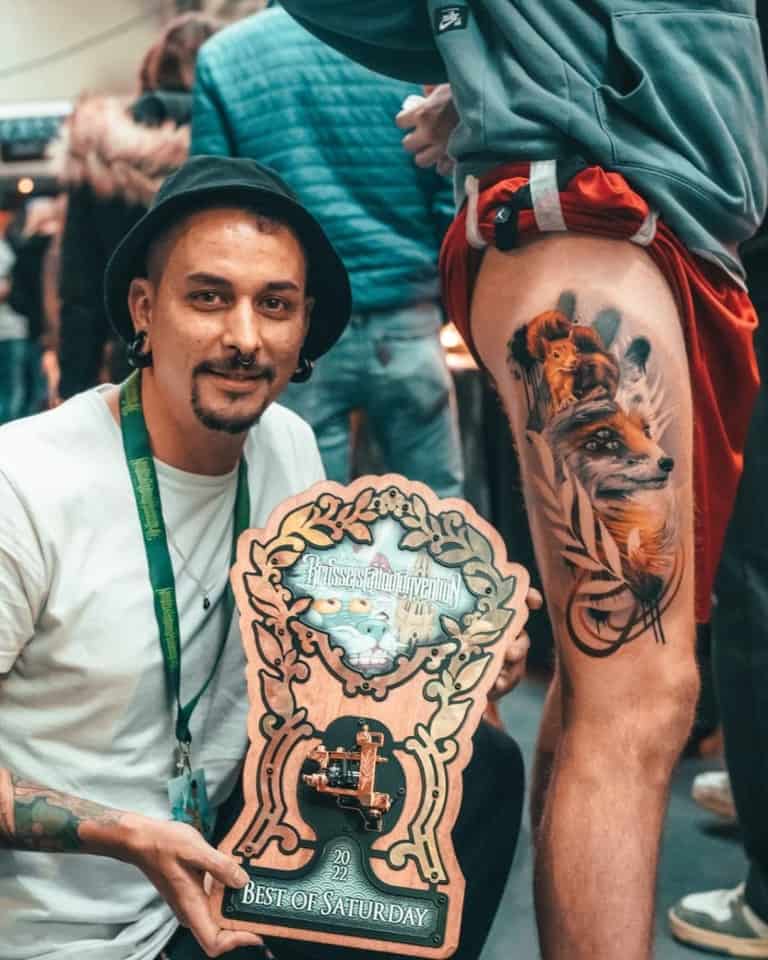
His work focuses on strong contrasts, depth, and realistic elements that bring visual impact to the skin.
The themes he enjoys tattooing most often come from cinema, fantasy, and pop culture. Films, iconic characters, and imaginative worlds provide a rich source of inspiration for many of his designs.
Het ontwerpproces
Roland’s creative process begins long before the tattoo machine touches the skin.
He spends a significant amount of time researching images and references, sometimes over the course of several days. From these references, he selects the strongest elements and begins composing the design.
His process often includes:
-
Gathering and selecting reference images
-
Projecting them onto his drawing surface
-
Sketching and adjusting compositions
-
Erasing, redrawing, and creating montages
This iterative process allows him to refine the visual balance of the piece before the tattoo session begins.
Striving for Perfection
Roland describes himself as extremely critical of his own work. He constantly analyzes his projects and looks for ways to improve them.
Rather than focusing on what he already does well, he intentionally pushes toward areas where he can grow further as an artist. This mindset drives continuous development and experimentation within his craft.
The Most Satisfying Moment
Among the many stages of tattooing—design, application, and completion—Roland finds the greatest satisfaction in the final stage.
For him, the most rewarding moment comes during the finishing touches: adding subtle details, small references, or final adjustments that bring the piece fully to life.
Those final refinements often lead to the moment when he can step back and think:
“Yeah… that’s cool.”

Continuing to Evolve
Roland believes artistic growth comes from maintaining a critical mindset and a constant desire to improve. However, personal effort is only one part of the equation.
The tattoo community also plays a major role in that evolution. Conventions, collaborations, and meetings with other artists provide opportunities to exchange ideas, discover new techniques, and gain inspiration from the work of others.
Seeing innovative tattoos created by peers often sparks new ideas and pushes him to refine his own approach.

 English
  Dutch
Dutch  Dutch (Belgium)
  French
  German
  Spanish